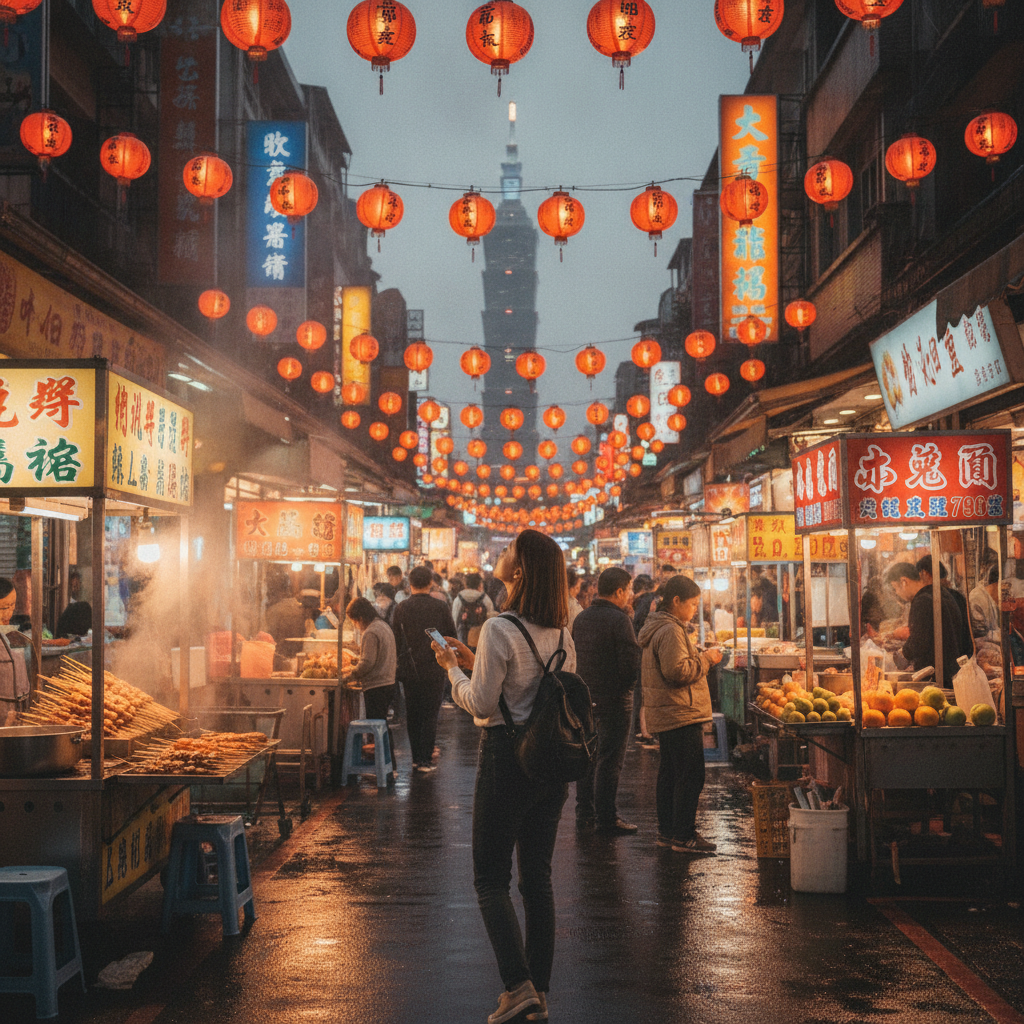
There is a particular kind of overwhelm that greets a first-time visitor to Taipei's night markets — not the unpleasant kind, but the breathless, wide-eyed variety that arrives when every sense is engaged simultaneously. The air carries the mingled scent of scallion pancakes frying in iron skillets and stinky tofu (*chòu dòufu*), the famously pungent fermented bean curd that locals adore and newcomers approach with cautious curiosity. Crowds move in loose, unhurried currents between stalls lit by fluorescent tubes and paper lanterns. For a solo traveler arriving without a companion to share the confusion, this sensory abundance can feel like a test. It isn't. It's an invitation.
Reading the Market Before You Eat
Taipei's night markets are not interchangeable. Each has a distinct character shaped by its neighborhood, its clientele, and the particular foods it has become known for over generations. Shilin Night Market, in the Shilin district, is the largest and most internationally recognized, drawing a mix of tourists and locals across two levels of basement food stalls and open-air vendor lanes. Raohe Street Night Market, running along a single long corridor near Songshan, has a more concentrated, atmospheric quality — the Songshan Ciyou Temple anchors one end, and the stall lineup is tighter, older, and more consistent. Ningxia Night Market, smaller and less photographed, is often cited by food-minded visitors as the best expression of Taiwanese culinary tradition without the tourist-density crowds. Spending a few minutes simply walking the full length of a market before buying anything is not wasted time — it's the most efficient way to understand what's available, where the queues are forming, and which stalls have earned the quiet authority of a long line.
Queues matter enormously in this context. A cluster of people waiting patiently in front of a modest stall is a more reliable recommendation than any review site. The vendors who have been operating from the same position for a decade or more know it, and so do the regulars who return to them. *Pàigu* (spare rib) soup at Raohe's most famous braised pork stall, or the pepper buns baked in a clay oven near the temple entrance, carry decades of accumulated refinement in their preparation. Watching how a vendor moves — efficiently, without hesitation, with an ease that comes only from repetition — is itself a kind of information.
Managing Pace and Money Without Anxiety
Cash remains the dominant currency of night market transactions, and visiting an ATM before arriving is one of the more practical things a solo traveler can do. Most stalls do not accept cards, and fumbling for a payment app at a busy counter creates unnecessary friction. Taiwanese dollars are small in denomination relative to most Western currencies, which means wallets fill quickly with coins. Keeping small bills separate makes transactions faster and less awkward. A modest budget per market visit — enough for four to six items — prevents the impulse to buy indiscriminately from every compelling stall and allows for a more considered experience overall.
The portion logic of night market eating is important to understand early. Most items are designed for snacking, not for a full meal constructed at a single stall. *Oyster vermicelli* (*ô-á-mī-suànn*), a thick, slightly gelatinous dish of oysters and sweet potato starch noodles in a savory sauce, arrives in a modest bowl. *Bubble tea* (*zhēnzhū nǎichá*), the milk tea with tapioca pearls that originated in Taiwan, is a drink that can anchor a wandering visit rather than a meal unto itself. Grilled corn, scallion crepes, and small portions of *lu rou fan* — braised pork rice — are the kind of items that accumulate pleasurably into a full evening rather than needing to be consumed in a single sitting.
Moving Solo Through a Crowd
Night markets are dense, and the unspoken etiquette of moving through them is worth observing before it becomes a source of stress. Stopping in the center of a thoroughfare to examine a menu or photograph a stall will draw the polite but unmistakable pressure of bodies moving around a fixed obstacle. Moving to the edge before pausing is a small adjustment that aligns a visitor with the natural flow of the market rather than working against it. Locals rarely seem to rush, but they move with a consistent, purposeful ease that comes from knowing exactly where they're going. A first-time visitor who permits themselves to slow down and observe rather than consuming urgently will find the experience far less exhausting.
For navigating between markets, Taipei's MRT system — the Mass Rapid Transit — connects most major market neighborhoods directly. The Danshui-Xinyi Line stops near Shilin; Raohe is accessible from Songshan Station on the Neihu Line. Downloading the Taipei Metro app provides real-time route guidance in English, and the EasyCard, a reloadable transit card available at any MRT station, makes fares seamless. Between markets, the MRT offers a useful pause — a few quiet minutes before the next wave of sensation.
What the Night Market Is Really Offering
For you, the solo traveler arriving in Taipei for the first time, the night market is less about checking off a list of famous foods and more about learning to be at ease inside a culture that moves at its own pace and according to its own logic. The vendors are not performing for visitors — they are working, maintaining a livelihood, and producing food they take seriously. Approaching each transaction with patience and a willingness to point rather than pronounce, to gesture toward the thing rather than name it imperfectly, tends to be met with warmth. A small bow of acknowledgment, a genuine *xièxiè* (thank you), costs nothing and changes the texture of an interaction entirely. The market rewards attentiveness over efficiency.
Solo travel in a place like Taipei asks something specific of a person: the willingness to be uncertain without being undone by it. The night markets, with all their noise and heat and abundance, are ultimately organized around a very human impulse — to gather, to eat well, and to do it again tomorrow. The traveler who arrived overwhelmed at the entrance, who paused to read the crowd before joining it, who spent an evening eating slowly and watching carefully, will leave having understood something real about the city. That understanding begins, as it so often does, with the smell of something unfamiliar cooking just out of sight.