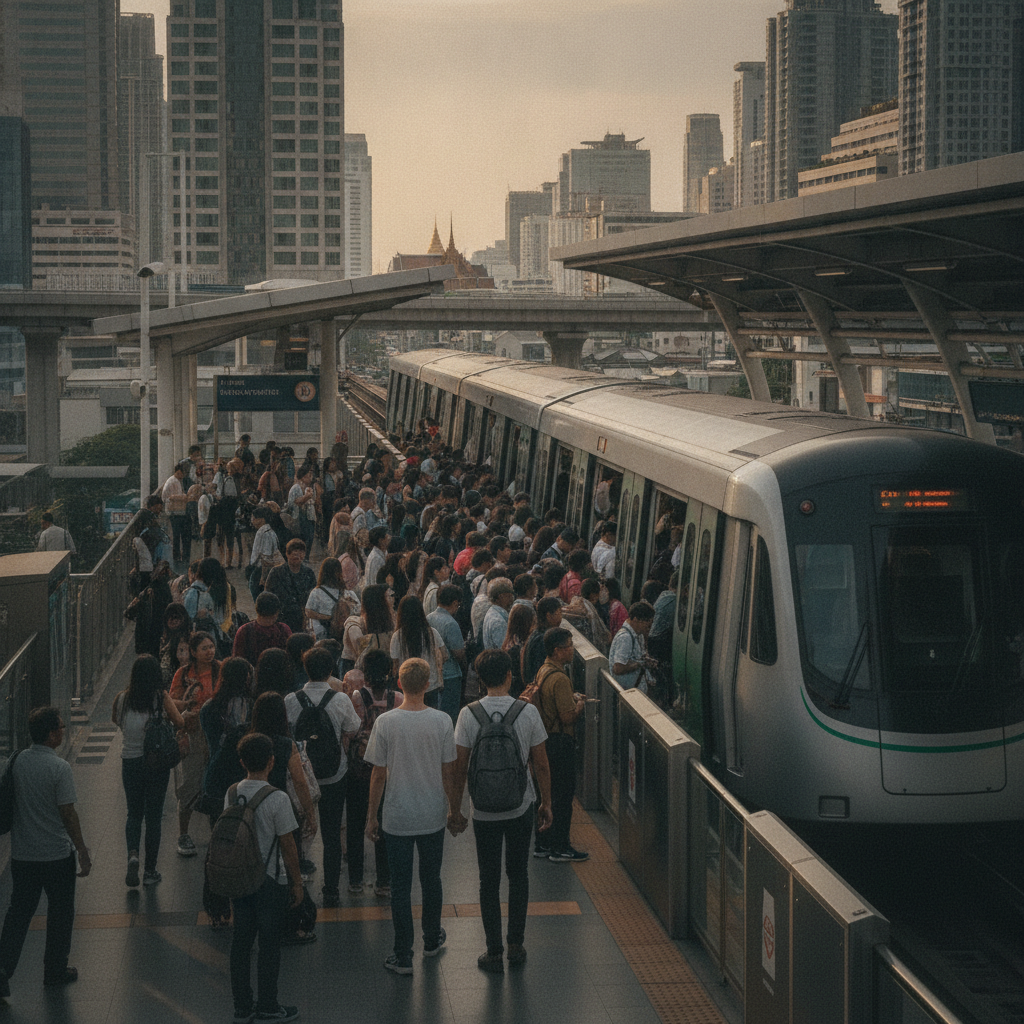
Bangkok's BTS Skytrain is one of Southeast Asia's most efficient urban rail systems — and during rush hour, it can also feel like one of the most overwhelming. If you've just arrived in the city and found yourself wedged between strangers at Siam station while a three-car train pulls away completely full, you're already learning the most important lesson: peak-hour Bangkok requires a little strategy.
The good news is that the system itself is genuinely well-designed. Clean, air-conditioned, and color-coded, the BTS runs across two main lines — the Sukhumvit Line and the Silom Line — connecting most of the neighborhoods you'll actually want to reach. A few smart adjustments to how and when you use it will make a real difference.
Load Your Rabbit Card Before You Need It
Buying a ticket at the machine during rush hour is a slow, stressful experience. The queues are long, the machines have limited English, and you'll be doing all of this while commuters push past you with practiced efficiency. Pick up a Rabbit Card — the BTS's stored-value card — from any major station on a quieter afternoon. Load it with enough credit for several days of travel. You tap on, tap off, and skip the queue entirely. The card also works at some retailers near stations, which is a nice bonus.
Time Your Trips Around the Rush
Peak hours on the BTS run roughly from 7:30 to 9:30 in the morning and again from 5:00 to 8:00 in the evening. Trains during these windows are genuinely packed — standing room only, with passengers crowded into every available space. If your itinerary is flexible, shifting your departure by even 45 minutes can change the experience entirely. A mid-morning trip from Asok to National Stadium, for example, is a pleasant, uncrowded ride. The same journey at 8:15am involves a level of closeness with strangers that most first-time visitors find surprising.
Stand in the Right Spot on the Platform
BTS platforms have marked waiting zones that line up with the train doors. During peak hours, these zones form into loose queues, and boarding is faster and less chaotic when you join them properly. Avoid standing in the middle of the platform where passengers are trying to exit — hold to the sides of the door markers instead. This is standard behavior for regular commuters, and following it signals to everyone around you that you know what you're doing, even if you're new.
Use the Interchange Stations Strategically
Siam is the central interchange between the Sukhumvit and Silom lines, and during rush hour it's the busiest point in the entire network. If your route takes you through Siam at peak time, try to plan a short window for the transfer rather than rushing through it. Asok and Mo Chit are also high-traffic stations. When you can, use less congested interchange options — or plan your route to avoid a transfer during the busiest part of the day altogether. The BTS map is available in English and easy to read once you've spent a few minutes with it.
Download the Right Apps Before You Arrive
Two apps make using Bangkok's transit system significantly easier. Google Maps handles BTS routing well and will give you real-time departure estimates. For a more Bangkok-specific experience, Via Bus Bangkok covers the broader transit network including buses and the MRT subway. Knowing your route before you reach the station means you spend less time staring at maps on the platform and more time moving with purpose. Mobile data in Bangkok is inexpensive and widely available, so staying connected while you travel is easy to arrange on arrival.
Know When to Skip the BTS Entirely
For short distances in low-traffic conditions, a metered taxi or a Grab ride (Southeast Asia's equivalent of Uber) can actually be faster and more comfortable than the BTS. Where the Skytrain really earns its reputation is for longer cross-city trips — say, from On Nut to Chong Nonsi — especially when surface roads are gridlocked, which is often. Rush-hour traffic in Bangkok is legendary, and sitting in a taxi for 40 minutes to cover two kilometers is a real possibility. Use the BTS for the big moves across the city, and save surface transport for shorter, off-peak trips.
Give Yourself More Time Than You Think You Need
First-time visitors consistently underestimate how long it takes to get between BTS stations and their final destination. The station itself might be at street level or several floors up, and the walk from the exit to your hotel, restaurant, or attraction can add 10 to 20 minutes that aren't reflected in your map's travel estimate. Factor in time to find the right exit — most major stations have four or more, and they lead to very different parts of the surrounding area. Exit numbers are well-marked, and matching the exit number to your destination address is a habit worth developing quickly.
Learn the Etiquette Early
Bangkok commuters have a quietly understood set of behaviors on the BTS that make the system work. Let passengers exit before you board, even when the train is crowded. Don't eat or drink on the train — it's prohibited and generally frowned upon. Priority seating near the doors is genuinely reserved for elderly passengers, monks, and pregnant women, and giving it up promptly when needed is expected. Small things like these go a long way toward making your journey smoother and earning a little goodwill from the people around you.
The BTS Skytrain rewards visitors who treat it as a real transit system rather than a tourist attraction. Once you have your Rabbit Card loaded, your route planned, and your timing dialed in, getting around Bangkok by rail feels less like a challenge and more like one of the city's genuine pleasures. Start with one simple ride on a quieter stretch of the Sukhumvit Line, get comfortable with the flow, and build from there.