Some neighborhoods resist being summarized. They hold their character in the details — in the way a particular alley smells of jasmine and grilled sardines, or in the sound of a fado melody drifting from a window that no guidebook has thought to mention. Mouraria, one of Lisbon's oldest and most layered districts, belongs firmly to this category. Tucked beneath the ramparts of São Jorge Castle and stretching down toward the Intendente square, it has long existed at the margins of the city's tourist circuit — which is precisely what makes a 48-hour stay there feel like a genuine act of discovery.
The Weight of History in Narrow Streets
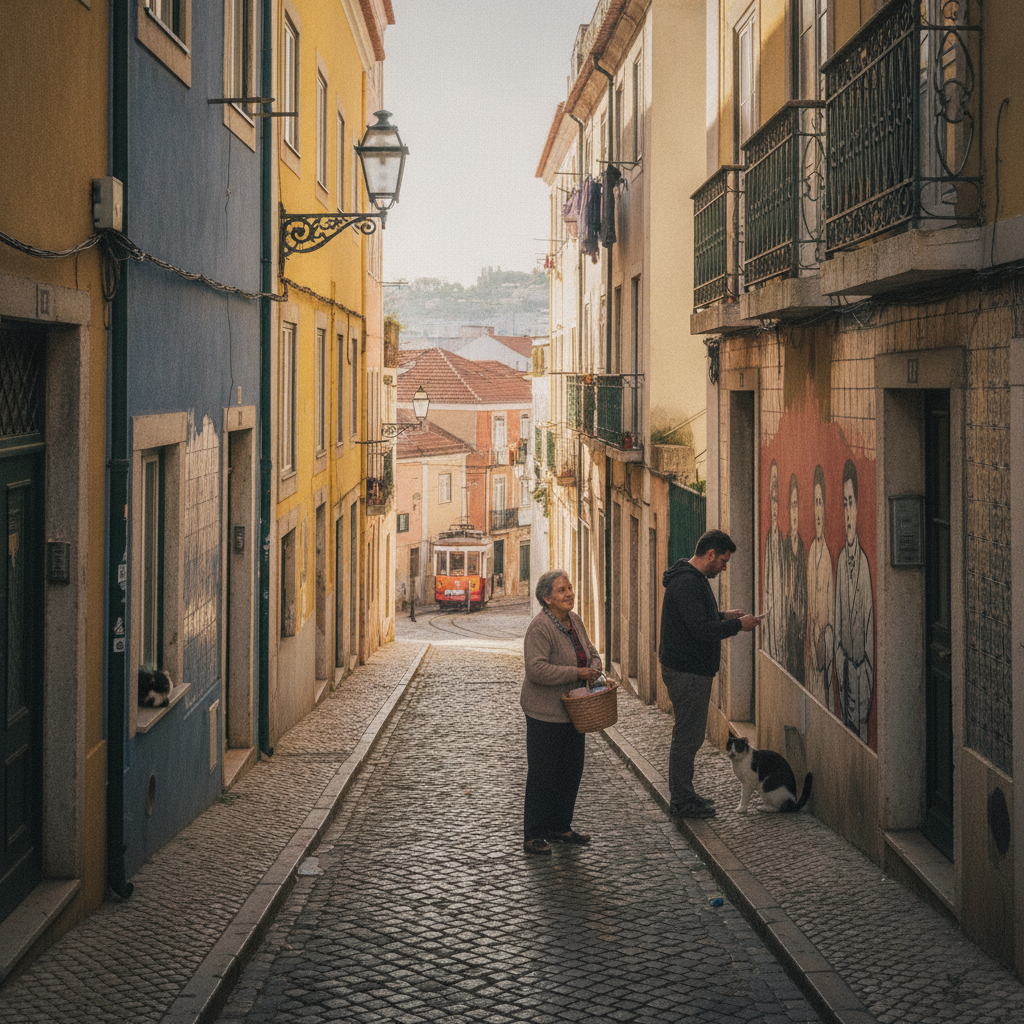
Mouraria's origins trace back to the Moorish community that settled here after the Christian reconquest of Lisbon in 1147, and that history is not merely decorative — it lives in the district's geometry, its textures, its cultural mix. The streets were not designed for efficiency; they wind and overlap in ways that make linear progress feel beside the point. This is a neighborhood where getting turned around is less a failure of navigation and more an invitation to notice something unplanned: a tiled staircase draped in potted geraniums, a corner grocery run by a family who has occupied the same address for decades, a small praça — a square — where older residents gather in the late afternoon with the unhurried ease of people who have nowhere more important to be. Walking without a map here is not a gimmick. It is the only method that allows the place to reveal itself at its own pace.
The architecture shifts constantly between eras, from Moorish-influenced archways to faded Pombaline facades to bold contemporary murals. Mouraria has been a destination for waves of immigrants — from Cape Verde, Bangladesh, China, and elsewhere — and that demographic history has made it one of Lisbon's most genuinely multicultural quarters. A single block might contain a traditional taberna serving petiscos, the Portuguese equivalent of tapas, alongside a South Asian spice shop and a modern ceramic studio run by a local artist. The district doesn't present these elements as a curated experience. They simply coexist, organically, in the way that only long-inhabited urban spaces tend to manage.
Where Fado Was Born and Where It Breathes
Fado — the Portuguese musical tradition of melancholic, soulful song — has deep roots in Mouraria, and the neighborhood makes no attempt to hide this pride. The genre is said to have taken its modern shape here in the early nineteenth century, shaped by the voices and lives of the district's working-class residents. The Museu do Fado, located just at the edge of Alfama, provides historical context for those who want it, but the more immediate experience comes from smaller venues within Mouraria itself. On evenings when a tasca — a simple, intimate tavern — decides to host a fadista, the music feels less like performance and more like collective memory being spoken aloud. The saudade, a Portuguese word describing a bittersweet longing that resists easy translation, is not something that can be hurried or scheduled. It tends to arrive when least expected, in a voice that carries across a room too small to contain it comfortably.
Morning Rhythms and the Ritual of Coffee
A 48-hour stay in Mouraria earns its shape through repetition as much as novelty. Both mornings carry a similar logic: espresso standing at a counter, a pastel de nata — a warm custard tart with a caramelized surface — eaten without particular ceremony, and a slow walk before the streets fill. The Intendente square, once neglected and now quietly revived, offers good light in the early hours and a sense of the neighborhood at its most unguarded. The vendors setting up, the pigeons navigating the fountain, the café owners pulling back their shutters with the practiced indifference of people who have done this every morning for years — these are the textures that don't appear in any list of recommended attractions, but that accumulate into something that feels, by the end of 48 hours, like a genuine sense of place.
Lunch on both days is best approached as a series of small decisions rather than a single destination. A counter serving bifanas — pork sandwiches in a roll, seasoned with mustard and garlic — requires no reservation and very little money. A small restaurant without an English menu is rarely a problem; pointing and accepting what arrives is a reasonable and often rewarding strategy. The absence of a plan is not a hardship. It is a framework.
How to Leave Mouraria Well
By the time 48 hours have passed, the neighborhood will feel less like a location visited and more like a place briefly inhabited. You will have a few streets committed to memory, a preferred corner for afternoon coffee, and perhaps a half-remembered melody from a late evening in a crowded tasca. The work of a place like Mouraria is not to impress — it doesn't try to — but to persist, stubbornly and beautifully, in being exactly what it is. Take the 28 tram back through Alfama if the legs need rest, or walk the long way to the riverfront and let the city expand again around you. Either way, the return to a wider Lisbon will feel like surfacing from something quiet and specific into something larger and more general. The narrow streets and their unhurried rhythms will stay with you in the way that only unplanned hours tend to — not as photographs, but as a feeling that the world occasionally makes room for exactly this kind of attention.