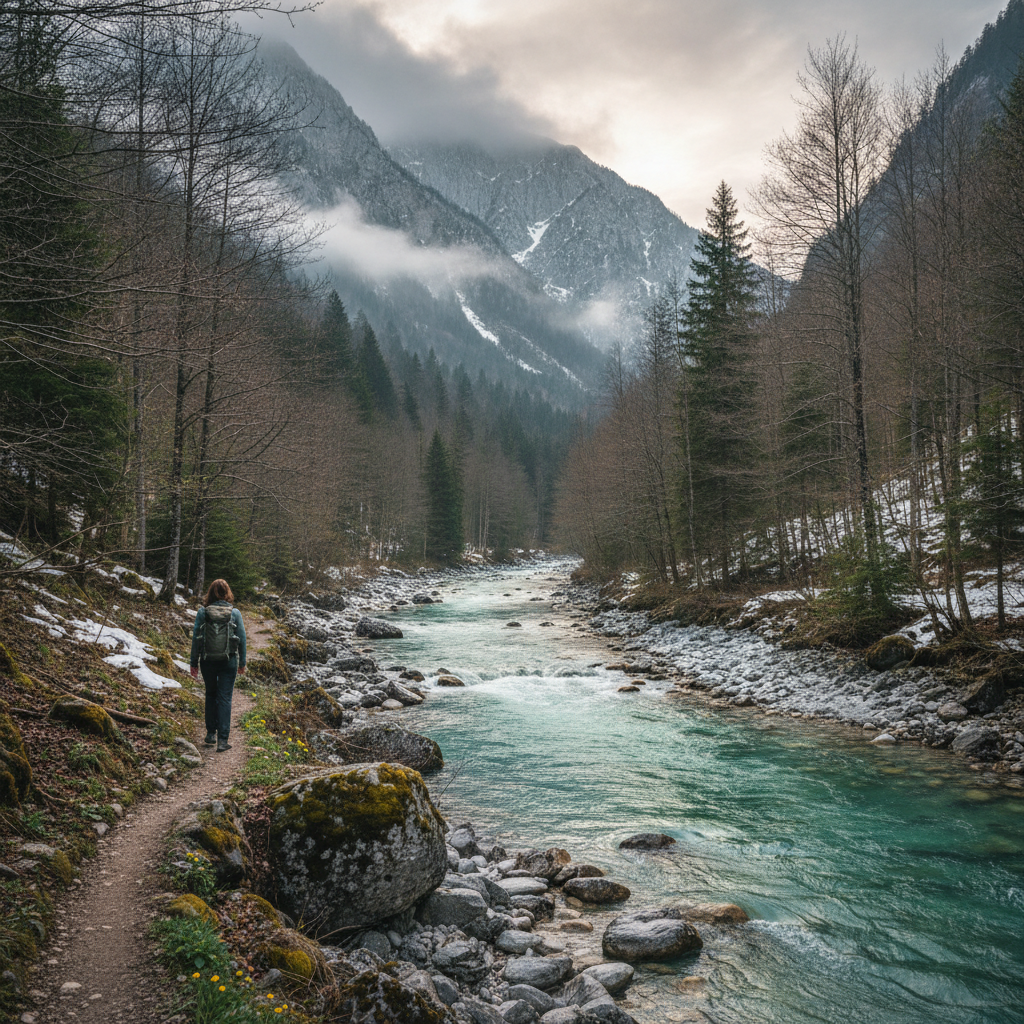
Early spring has a particular way of deceiving travelers who arrive expecting either the pristine silence of winter or the full bloom of warmer months. In Slovenia's Soča Valley, that in-between quality isn't a disappointment — it's the whole point. The trails are quiet, the river runs an almost unnatural shade of turquoise from snowmelt, and the villages that line the valley floor haven't yet shifted into high-season mode. For a solo hiker, this window between late February and mid-April offers something that peak summer simply can't: uninterrupted access to one of the most striking landscapes in Central Europe, without the logistical noise of crowds.
What Does the Valley Actually Look Like Before the Season Opens?
The Soča River is the defining feature of this region, and in early spring it's running fast and cold, fed by snowfields still clinging to the Triglav massif above. The water's color — that famous blue-green that appears in almost every photograph of the valley — is most vivid at this time of year, when glacial runoff is at its peak and the surrounding riverbanks haven't yet been worn down by foot traffic. You'll walk paths through beech forests where the trees are still bare enough to let afternoon light reach the ground, and the effect is stark and genuinely beautiful in a way that summer's full canopy obscures.
The village of Bovec serves as the natural base for most hikers coming into the valley. It's a small town, and in early spring it operates at a reduced pace — some restaurants open only on weekends, a few guesthouses won't begin accepting bookings until May, and the adventure sports operators who fill the valley with rafters and canyoners in summer are still in their pre-season quiet. This reduced infrastructure isn't a problem if you plan correctly. The guesthouses that do stay open year-round tend to be the ones with the most reliable kitchens and the owners most willing to talk trail conditions with you over breakfast. That access to local knowledge is genuinely worth the slight inconvenience of a shorter list of accommodation options.
How to Time Your Days Around the Weather
Early spring weather in the Julian Alps moves quickly. A morning that begins with clear skies can shift to low cloud and light rain by early afternoon, and then clear again before sunset. The practical implication for solo hikers is that you should plan to start longer routes early — by seven or eight in the morning if possible — and treat mid-afternoon as a natural rest or acclimatization window rather than prime hiking time. Apps like Yr, the Norwegian meteorological service that covers Alpine Europe with reliable short-range forecasting, are considerably more useful here than general weather platforms. Mountain-specific forecasts on Yr account for elevation changes that make a significant difference when you're deciding whether a ridge route is reasonable on a given day.
The classic day hikes from Bovec — routes along the Soča Trail, up toward Krn Lake, or through the Lepena Valley — are generally accessible by March, though higher-elevation variants may require microspikes depending on residual snowpack. Checking conditions through Trailfork before committing to a specific route each morning is worth building into your daily rhythm. The platform's community-reported trail conditions are updated frequently enough to be genuinely useful rather than misleading.
How Do You Actually Get Around Without a Car?
This is the question that stops some solo travelers before they even begin planning a Soča Valley trip, and the honest answer is that it requires more intentionality than a car-based itinerary — but it's entirely workable. The AP Prevoz bus service connects Bovec to Kobarid and onward to Most na Soči, which itself links to rail connections toward Ljubljana. In early spring, the frequency is lower than in summer, which means a missed bus becomes a meaningful inconvenience rather than a minor delay. Building a loose buffer into each day's plan — accepting that you might spend an extra hour in Kobarid before the next departure — tends to convert what feels like a limitation into an opportunity to explore a place more slowly.
Kobarid itself is worth more than a transit stop. The town's museum covering the Isonzo Front — the brutal World War One campaign fought largely across this valley — offers one of the more affecting small-museum experiences in Europe. It reframes the entire landscape you're walking through, and many hikers find that spending a half-day there before tackling the surrounding trails gives the terrain a weight and context it might otherwise lack.
What to Pack That Most Spring Hikers Underestimate
The Soča Valley's early spring conditions sit in a gear category that's easy to misread. The air temperatures in the valley floor can feel mild — sometimes genuinely warm at midday — but elevation gain of even five hundred meters can drop you into conditions that feel like January. Waterproof layers that pack small are essential, not optional. Merino base layers perform better here than synthetic alternatives because the temperature swings make moisture management more important than pure insulation. Trail running shoes with a waterproof membrane are a reasonable choice for lower valley routes, but anything involving snowpack above fifteen hundred meters warrants a proper hiking boot with ankle support.
For navigation, the Mapy.cz app covers Slovenian trails with considerably more detail than Google Maps, including accurate trail markings for routes that aren't well-represented on mainstream platforms. Downloading the relevant region offline before leaving Bovec is a simple step that removes a significant point of vulnerability for days when you're in terrain with limited mobile coverage.
What Does a Full Week Actually Feel Like, Day by Day?
The rhythm of a week in the Soča Valley in early spring tends to find its own shape after the first couple of days. The first day usually involves adjustment — calibrating to the light, the pace of the village, the particular cold of the river when you stop to fill a water bottle. By the third day, most solo hikers report falling into a pattern that alternates between ambitious trail days and slower mornings spent walking the valley floor or reading in a guesthouse common room while rain moves through. This isn't a valley that rewards relentless motion. Its appeal is cumulative and quiet, built from repeated encounters with the same river at different points along its length, the same mountain profiles seen from different angles as clouds shift.
The final day or two often feel unhurried in a way that's difficult to manufacture. You've walked enough to be genuinely tired, eaten well from guesthouses serving local dishes built around seasonal vegetables and cured meats, and spent enough time without a packed agenda to feel the valley's particular rhythm settle into something close to your own. That's the experience early spring offers a solo hiker here — not a checklist of accomplished summits, but a week-long encounter with a place that's still deciding what season it belongs to, which turns out to be a surprisingly good mirror for the restless, searching quality that tends to bring people to solo travel in the first place.