Sri Lanka's rail network is one of the most scenic and logistically underused travel frameworks in South Asia, yet most two-week itineraries still treat it as an afterthought. Travelers who build their schedule around train routes rather than a checklist of popular destinations tend to move more fluidly, spend less time doubling back, and encounter a more grounded version of the country along the way. The network isn't perfect — delays are common, and not every region is covered — but its core lines connect enough key areas to anchor a genuinely satisfying fortnight.
Why the Rail Map Makes a Better Starting Point
Most packaged Sri Lanka itineraries follow a loop: Colombo to Kandy, then south to the beaches, with perhaps a cultural triangle detour thrown in. This approach works, but it often means long van transfers between points that don't connect naturally by road. The rail map, by contrast, reveals a different logic. Three main lines — the Main Line heading into the hill country, the Coastal Line running south from Colombo Fort, and the Northern Line toward Jaffna — form a practical spine that can be used to organize a two-week journey with far less redundancy.
The Colombo Fort Station as the Natural Starting Point
Every train-based itinerary in Sri Lanka begins or passes through Colombo Fort station. Rather than treating the capital as a single overnight stop, spending two or three days in Colombo allows travelers to understand the city's rhythm before committing to the slower pace of the interior. The Pettah neighborhood, immediately adjacent to the station, offers a dense, unfiltered version of daily commerce that many visitors bypass entirely. From Fort, trains depart for Kandy with relative frequency, making it the most logical first segment — comfortable, scenic, and easy to book in advance through the official Sri Lanka Railways website.
The Hill Country Line: The Most Rewarding Leg
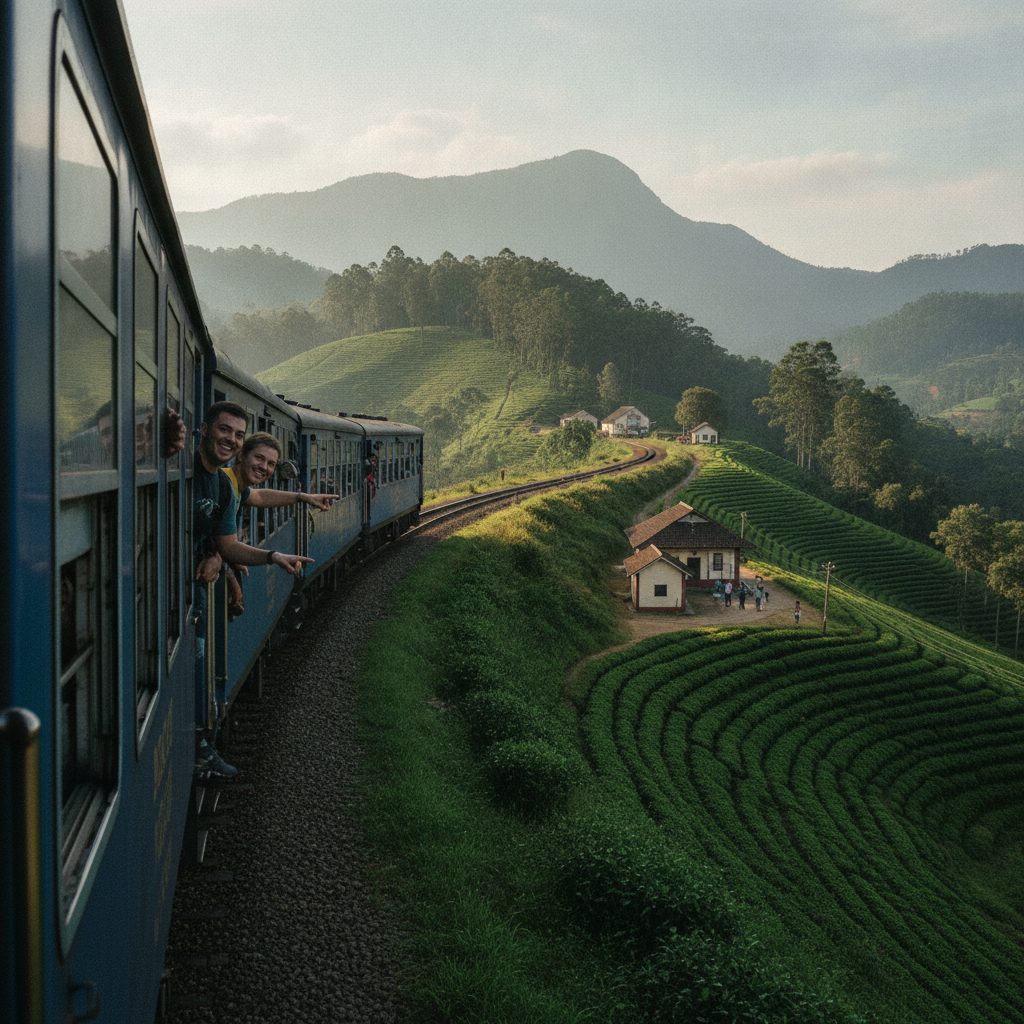
The journey from Kandy to Ella via the Badulla line is regularly cited as one of the most visually striking train rides in the world, and the reality largely holds up to that reputation. The route climbs through tea estates, crosses the Nine Arches Bridge near Demodara, and passes through Nuwara Eliya — a colonial-era hill town worth a one-night stop. Rather than booking the entire stretch at once, experienced travelers often break this leg into two segments, stopping at Hatton for access to Adam's Peak before continuing toward Ella. Each segment reveals a distinct microclimate and a different texture of highland life.
Structuring Time in the South Without Losing the Thread
From Ella, a bus connection to Matara links back into the Coastal Line, which runs west toward Colombo through Galle and Hikkaduwa. This southern arc works well as a second-week structure. Galle's fort district rewards slow exploration over two nights, and the train between Galle and Colombo remains one of the most reliable on the network. Travelers who want beach time can stop at Hikkaduwa without committing to a full resort stay. The key is treating the Coastal Line as a connector rather than a destination in itself — keeping movement purposeful and avoiding the temptation to simply follow the coastline until time runs out.
The Northern Extension: Jaffna for Those With Flexibility
The restored Northern Line to Jaffna represents a genuine shift in atmosphere. The peninsula has a distinct Tamil cultural identity, a different cuisine, and a quieter pace that contrasts sharply with the tourism-saturated south. Adding Jaffna requires a Colombo layover and a roughly six-hour train ride, which works best for travelers with at least three extra days and a genuine interest in a less-visited corner of the island. The city's colonial Dutch fort, the Nainativu island ferry, and the local jaffna crab curry scene collectively justify the detour for those whose itinerary has room to breathe.
Practical Booking and Timing Advice
When planning around train routes, booking observation car seats on the Kandy–Ella segment at least two weeks ahead is strongly recommended — they sell out consistently and the open-air experience is a significant step up from standard second class. You can reserve directly through the Sri Lanka Railways online portal or through third-party platforms like Bookaway, which offers a slightly more straightforward interface for international travelers. Budget for the possibility of delays, especially in the hill country, where weather can affect schedules. Build in at least one unstructured day per week so that a slow train doesn't cascade into a missed connection. Packing light matters more here than almost anywhere else — overhead luggage space is limited, and station transfers are more manageable with a single bag.
Organizing a Sri Lanka itinerary around its train routes rather than its tourist hubs shifts the entire experience. The journey becomes part of the destination, each line revealing a different layer of the country's geography and culture. The result is a two-week trip that feels coherent rather than rushed — one where the logistics support the travel rather than working against it.