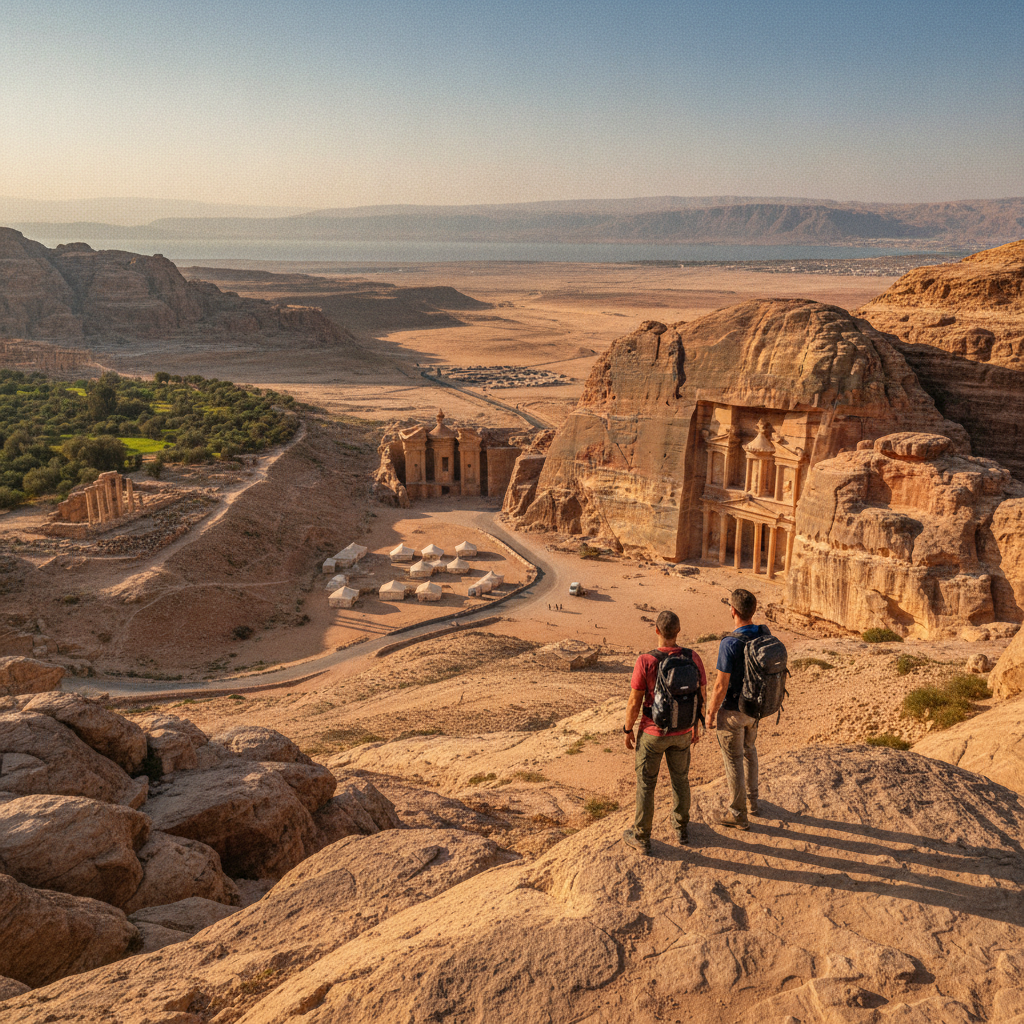
Jordan rewards visitors who treat it as more than a single destination. Petra is extraordinary — few archaeological sites on earth match its scale, drama, or emotional weight — but a two-week itinerary built entirely around one site tends to collapse into a before-and-after structure that shortchanges everywhere else. The country offers desert landscapes, Roman ruins, Red Sea coastline, and some of the most hospitable culture in the Middle East. The key is distributing attention deliberately so that Petra earns its place as a centerpiece without becoming the only thing worth remembering.
Anchoring the First Days in Amman's Old City
Amman is often treated as a transit hub, but the city's older neighborhoods offer a genuinely distinct introduction to Jordanian life. The district of Jabal al-Weibdeh contains art galleries, independent coffee shops, and Ottoman-era architecture that rewards slow walking rather than guided tours. The Citadel and the Roman Theatre give visitors an early sense of the country's layered history before they arrive at sites that require more focused engagement. Spending two nights in Amman also allows travelers to adjust to local rhythms, manage jet lag, and gather practical information from guesthouses and locals who know the rest of the country well.
Using Madaba and the King's Highway as a Transition Route
The drive south along the King's Highway is one of Jordan's most underappreciated travel decisions. Rather than heading directly to Petra via the Desert Highway, routing through Madaba, Mount Nebo, and the Wadi Mujib canyon gorge turns what could be a single transit day into a sequence of genuinely distinct experiences. Madaba is known for its Byzantine mosaic map of the Holy Land, one of the oldest surviving cartographic depictions of the region, and it takes no more than a few hours to appreciate properly. Mount Nebo offers a sweeping view that carries both religious and geographic significance. Breaking the southern journey this way means Petra arrives with context rather than as an isolated spectacle.
Giving Petra Two Full Days Instead of One
Most visitors allocate a single day to Petra and leave having seen the Treasury, the Siq, and little else. Two full days changes the experience substantially. The first day can follow the main trail at a relaxed pace, reaching the Monastery — a climb that many travelers skip — in the late afternoon when the light shifts and crowds thin. The second day opens access to lesser-visited trails including the High Place of Sacrifice and the rear routes toward Little Petra at Siq al-Barid. Staying in Wadi Musa rather than day-tripping from Aqaba also allows for an early morning entrance before tour groups arrive, which transforms the Siq into something closer to a private encounter.
Letting Wadi Rum Stand on Its Own Terms
Wadi Rum is sometimes positioned as an overnight add-on squeezed between Petra and Aqaba, which undersells it considerably. The desert landscape — a protected area covering hundreds of square kilometers of sandstone and granite — deserves at least two nights. Staying in one of the permanent Bedouin-run camps rather than a luxury glamping operation tends to offer a more grounded experience and better access to guides who know the terrain without fixed itineraries. Sunrise and sunset in Wadi Rum are not simply photogenic; they're genuinely disorienting in how completely the color and scale of the environment shifts. Treating Wadi Rum as its own destination rather than a scenic detour brings the itinerary into proper balance.
Building Aqaba Into the Final Stretch
Aqaba sits at Jordan's narrow southern coastal strip on the Red Sea and functions well as a decompression point in the final days of a two-week trip. The snorkeling and diving are serious enough to occupy dedicated travelers, with coral reefs within easy reach of the shoreline and dive operators offering half-day outings without requiring advanced certification. The city itself is more relaxed than Amman, with a waterfront promenade and a compact old quarter that fills up in the evenings. Ending the itinerary here rather than looping back north also gives travelers a natural sense of geographic completion — the country has been crossed from capital to coast.
Practical Pacing Tips for the Full Two Weeks
For your planning, a workable two-week structure looks roughly like this: two nights in Amman, one night in Madaba, one night near Wadi Mujib, two nights in Wadi Musa for Petra, two nights in Wadi Rum, and two nights in Aqaba, leaving a buffer day that can shift based on energy or interest. The Jordan Pass covers entry to Petra and over forty other sites, and it's worth purchasing before arrival since it also includes the visa fee. Hiring a local guide for at least one full day in Petra and one excursion in Wadi Rum adds depth that self-guided exploration rarely matches. Renting a car for the King's Highway section gives the most flexibility, though shared taxis and minibuses connect the major southern stops reliably enough for travelers who prefer not to drive.
Jordan's appeal as a destination continues to grow among travelers who prioritize history, landscape, and cultural engagement over beach-resort comfort. As more visitors discover that the country offers considerably more than its most famous site, itineraries are shifting toward slower, more distributed approaches that treat the whole country as the destination. For anyone planning a first or return visit, the most satisfying two weeks are almost always the ones that resist the gravitational pull of Petra just enough to leave room for everything that surrounds it.