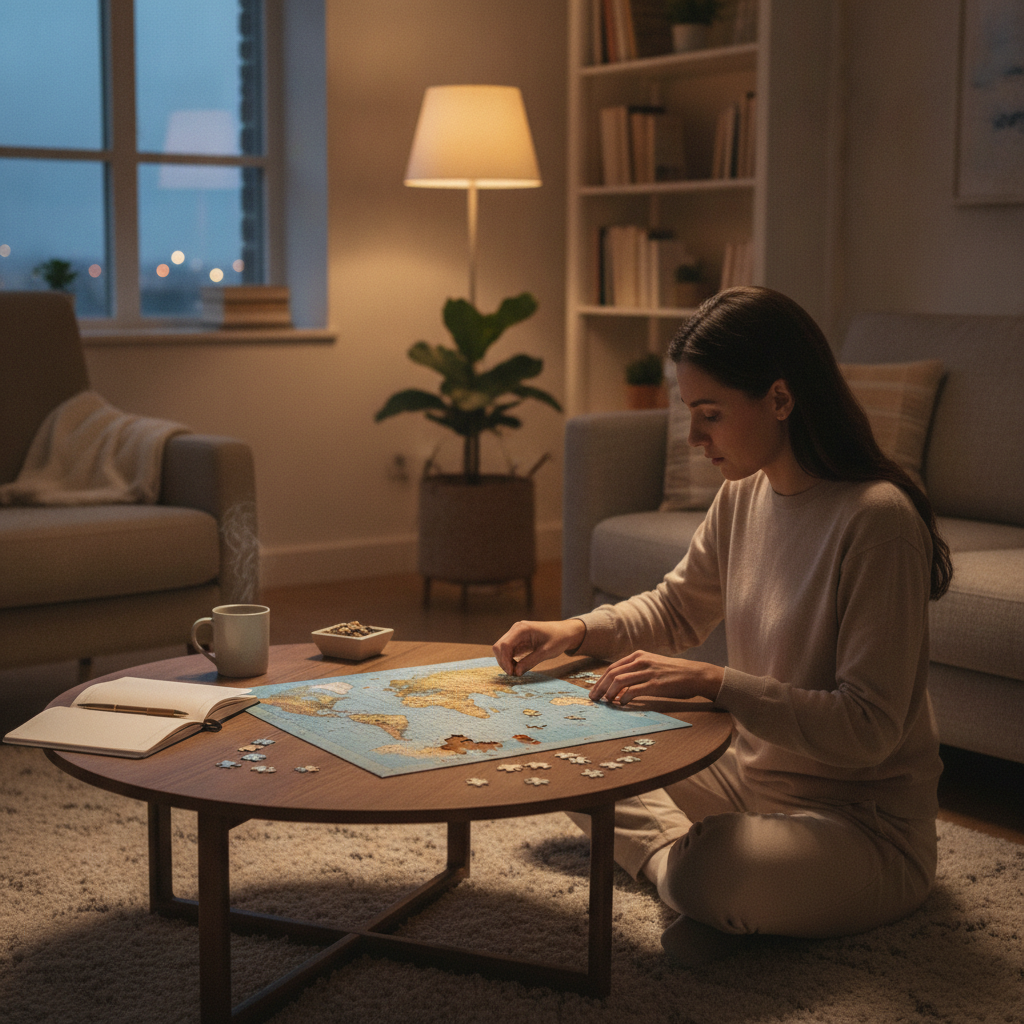
Most evenings don't fall apart dramatically — they just dissolve. You finish work, maybe eat something, scroll for a while, watch half a show, and then it's somehow ten o'clock and you're not sure where the time went. That familiar sense of having lost an evening without actually resting or accomplishing anything is one of the quieter frustrations of adult life. It's not laziness, and it's not a lack of discipline. It's drift — the natural result of an unstructured block of time with too many low-effort options competing for your attention.
The fix doesn't require a rigid schedule or a productivity system. It requires one thing: an anchor. A single activity you return to each weeknight that gives the evening a center of gravity. Everything else can stay loose around it. But once that anchor is in place, the whole evening tends to organize itself more naturally — and you stop going to bed feeling like the night slipped away from you.
What Does an Anchor Activity Actually Do?
An anchor activity works the same way a focal point works in a room — it gives structure to everything around it without demanding that everything be perfectly arranged. When you know that at seven o'clock you sit down to read, or practice guitar, or go for a walk through your neighborhood, that commitment acts as a kind of spine for the evening. The hours before it feel purposeful because you're moving toward something. The hours after it feel earned because you've already done something real. The restless scroll-and-drift pattern loses its grip because there's a better default to return to.
How Do You Choose the Right Anchor?
The right anchor activity is one you can do consistently, not just enthusiastically. A lot of people make the mistake of choosing something that sounds compelling in theory but requires a high activation threshold — a full workout, an ambitious creative project, a long language lesson. These can work, but they're more fragile. Better options tend to be things you genuinely enjoy, that take between twenty and sixty minutes, and that don't require extensive setup or recovery. Reading a physical book, journaling, a short skill practice like duolingo or a musical instrument, a slow walk — these stick because they're accessible even on your worst days. Consistency beats ambition almost every time.
Why Does Timing Matter More Than You'd Think?
Where you place your anchor in the evening makes a real difference to how well it holds. Anchors placed too early — right after work — often get crowded out by logistics, meals, and the general chaos of transitioning home. Anchors placed too late lose their organizing power because the evening has already drifted by then. For most people, somewhere between 7:00 and 8:30 PM hits the sweet spot. You've had time to decompress and eat, but you haven't yet surrendered to the gravitational pull of the couch and your phone. Experimenting with your start time for a week or two usually reveals what feels natural for your own rhythm.
What Role Does Your Environment Play?
Environment shapes behavior more reliably than willpower does. If your anchor is reading, keeping a book on the kitchen table rather than buried in a bag signals your brain that reading is the default activity — not something you have to remember to do. If your anchor is a short walk, leaving your shoes near the door makes the decision easier before your motivation has a chance to waver. Apps like Streaks or Habitica can support the habit-building phase, but physical cues tend to work faster and require less maintenance. Small environmental nudges reduce the friction between intention and action in ways that internal motivation alone rarely can.
How Do You Keep Flexibility Without Losing the Anchor?
A good anchor is fixed enough to hold but loose enough not to become oppressive. If you treat your anchor like an appointment — something you protect but can reschedule when life genuinely interferes — it stays sustainable. The goal isn't perfect compliance; it's having a default to return to. On a night when a friend calls unexpectedly or work bleeds over, missing your anchor once doesn't undo the habit. What matters is that the anchor is your assumed plan, not a bonus activity you get to when everything else is handled. That shift in framing is where most of the value lives.
What Happens to Screen Time When an Anchor Is in Place?
One of the less obvious benefits of an anchor activity is what it does to passive screen time — not by eliminating it, but by compressing it into a more deliberate space. When the evening has a center, scrolling and streaming tend to migrate to the edges: a bit before the anchor, a bit after. They become something you choose rather than something you default into. Many people find they still watch Netflix or browse the same apps they always did, but the experience feels different because it's bounded rather than sprawling. Platforms like YouTube or Instagram don't disappear from the evening — they just stop running it.
How Long Before the Anchor Becomes Automatic?
The honest answer is longer than most habit advice suggests. Building a reliable anchor takes most people four to six weeks of consistent repetition before it starts feeling like a natural part of the evening rather than an effort. The first two weeks tend to feel mechanical. The middle weeks get easier as the pattern becomes familiar. By the end of the first month, many people report that skipping their anchor feels stranger than doing it — which is exactly when you know it's working. Patience during the early weeks is the most underrated part of the process. The anchor doesn't need to feel effortless yet; it just needs to happen.
What If You Have Different Energy Levels Each Night?
Not every evening lands the same way. Some nights you're genuinely depleted; others you feel capable of more than your anchor demands. A useful approach is to set a minimum version of your anchor activity — the smallest form it can take and still count. If your anchor is reading, ten pages is the floor. If it's a walk, fifteen minutes around the block qualifies. On high-energy nights, you can extend it naturally. On low-energy nights, the minimum version keeps the pattern intact without requiring you to override how you actually feel. This flexibility is what separates a sustainable anchor from a rule that breaks the first time life gets hard.
The feeling of a wasted evening rarely comes from doing too little. It comes from doing nothing with intention — from letting time move through you rather than moving through time deliberately. A single anchor activity doesn't transform your evenings into something productive or impressive. It just gives them a shape. And that shape, small as it sounds, is often the difference between going to bed feeling vaguely dissatisfied and going to bed feeling like the night was actually yours.