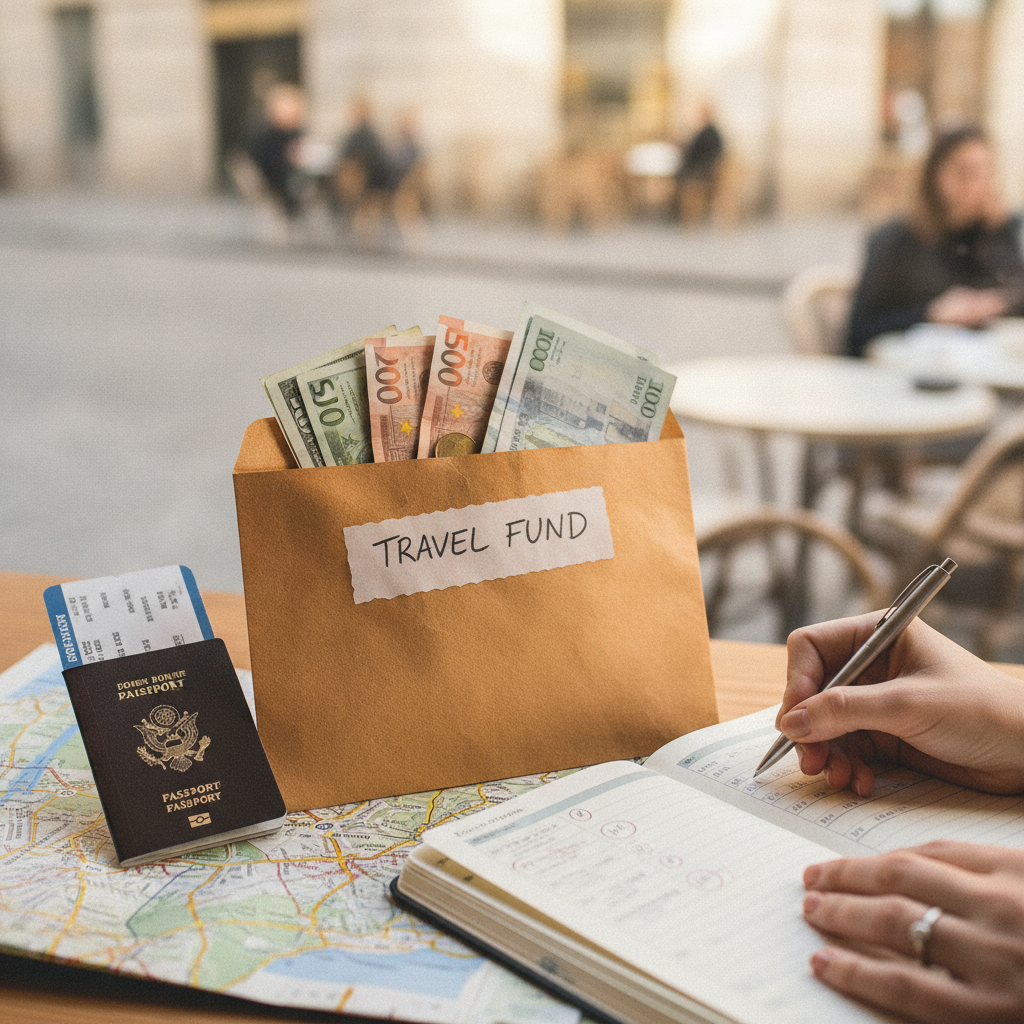
Most people who want to travel more aren't short on desire — they're short on a system that makes saving feel like it's actually leading somewhere. Money gets added to a general savings account, then pulled back out for car repairs, a new appliance, or a slow month at work. The trip stays abstract, perpetually weeks away from being financially ready. What changes that cycle isn't necessarily earning more or spending less. It's giving your travel money its own home — physically, mentally, and practically separate from everything else.
Name the Envelope Before You Put Anything In It
The act of labeling a small envelope or a separate savings bucket — writing "Portugal" or "Japan fund" or even just "next trip" on it — does something that a line in a spreadsheet doesn't. It converts a vague financial goal into something that has an identity. Apps like Ally or YNAB let you create labeled sub-savings goals within a single account, but a physical envelope on a desk works just as well for cash savers. The name matters because it makes every deposit feel intentional rather than incidental, and every withdrawal feel like a real decision with a real cost.
Start With Whatever Amount Feels Slightly Too Small
One of the most reliable ways to abandon a savings habit early is to set a contribution amount that strains your budget. When the number feels uncomfortable, you'll skip it during harder weeks and eventually stop feeling guilty about skipping it. Starting with an amount that feels almost embarrassingly modest — ten dollars a week, twenty, whatever genuinely doesn't register as a sacrifice — keeps the habit alive long enough to build momentum. The size of the fund matters less in the early weeks than the consistency of feeding it. A small envelope that grows slowly is far more motivating than an ambitious one that stalls.
Keep It Somewhere You Can See It Changing
Out of sight genuinely is out of mind when it comes to savings goals. A physical envelope tucked in a desk drawer, a glass jar on a shelf, or a pinned note tracking a digital sub-account balance somewhere visible all serve the same function: they make progress tangible. Seeing the number grow — even slowly — reinforces that the trip is becoming more real with each week. Cities like Kyoto and Lisbon feel aspirational and distant until you start watching the envelope thicken. Visual progress has a way of making abstract destinations feel geographically closer than they actually are.
Protect It From the Logic of "Just This Once"
The biggest threat to a dedicated travel fund isn't a genuine emergency — it's the reasonable-sounding request that isn't one. A birthday dinner that runs long, a sale at REI that seems too good to skip, a weekend that needs a last-minute hotel. The envelope survives these moments better when you've decided in advance what counts as a legitimate reason to pull from it. A simple rule — travel expenses only, not general lifestyle expenses — creates a boundary that's easy to explain to yourself and easier to honor than a vague intention to keep it safe.
Let a Small Windfall Accelerate It Naturally
Tax refunds, birthday money, a work bonus, or the occasional cash-back reward from a credit card like Chase Sapphire Preferred all represent money that wasn't already accounted for in your regular budget. Routing even a portion of those windfalls directly into your travel envelope produces a noticeable jump that regular weekly contributions can't replicate. These moments are worth planning for in advance — not by counting on them, but by knowing exactly where a surprise fifty or two hundred dollars will go the moment it arrives. Decision fatigue is real, and deciding in advance removes the temptation to absorb it into everyday spending.
Attach the Envelope to a Specific Trip, Not Just Travel in General
A fund labeled "travel" is useful. A fund labeled "ten days in Sri Lanka" is motivating. The more specific the destination and rough itinerary, the easier it becomes to research realistic costs, set a savings target, and feel the gap between where you are and where you need to be closing over time. Resources like Rome2rio or Google Flights make it practical to estimate flight windows and surface rough transportation costs early in the planning process. Specificity turns the envelope from a theoretical gesture into a project with a finish line, and finish lines make the whole effort feel worth sustaining.
Review the Envelope Once a Month, Not Once a Week
Checking too frequently creates pressure without producing useful information — your balance after five days looks almost identical to your balance after three. A monthly review gives you enough time to see genuine movement, recalibrate your timeline if needed, and adjust your contribution without second-guessing every week in between. Set a recurring reminder, open the envelope or sub-account, count what's there, and spend five minutes adjusting your timeline estimate. That's it. The review should feel like a check-in with something that's quietly working on your behalf, not a performance review of your self-discipline.
Let the Envelope Reframe What Everyday Spending Costs
Once you have a dedicated travel fund running, something subtle shifts in how you evaluate small purchases. A lunch out doesn't just cost what the bill says — it costs a contribution to the envelope you could have made instead. That mental comparison doesn't need to produce guilt or deprivation. It just makes trade-offs visible in a way that a combined savings account never does. When you can see that skipping an impulse purchase moves Oaxaca City or the Greek islands a few days closer, the choice becomes less about sacrifice and more about preference. The envelope makes the trade-off feel real rather than theoretical.
That's the quiet power of keeping travel money separated from everything else. It doesn't require a higher income or a dramatic lifestyle change — it requires giving your trip its own container and respecting what that container represents. The envelope becomes a kind of promise you make to yourself at the start of each week, and the longer you keep it, the harder it becomes to imagine planning any other way. Trips stop feeling like something that might eventually happen and start feeling like something that's already underway.