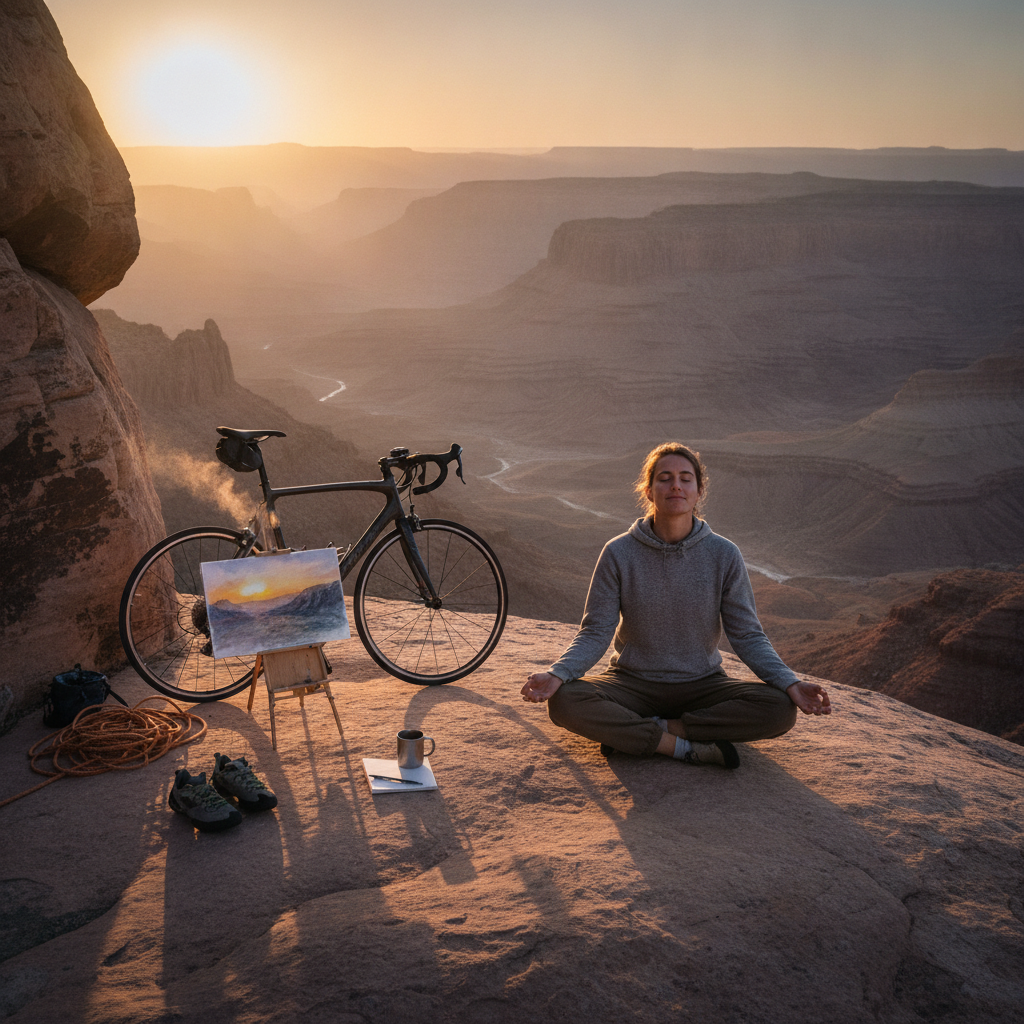
Rest, for most people, arrives as a passive condition — something that happens when obligations stop rather than something that is genuinely cultivated. Yet the quality of rest is rarely determined by the absence of activity; it's shaped, quietly and cumulatively, by the presence of certain kinds of engagement throughout the week. Among the most reliably transformative of these is the deliberate adoption of a physical hobby that demands complete cognitive presence — one that pulls a person so fully into the moment that the usual mental noise simply cannot compete.
When the Body Becomes a Channel for Focus
Activities like rock climbing, Brazilian jiu-jitsu, pottery throwing, or competitive rowing share a structural quality that most casual exercise lacks: they require the practitioner to think and move simultaneously, with consequences for lapsed attention. A climber who drifts mentally on a technical route will fall. A ceramicist whose focus wanders will feel it in the clay within seconds. This quality — sometimes described in sports psychology as *external focus* — shifts cognitive load away from internal rumination and places it firmly on immediate, physical problem-solving. Over weeks and months, this repeated redirection of attention begins to train the nervous system in ways that carry over far beyond the activity itself.
The Neurological Case for Demanding Hobbies
Physical activity that requires genuine skill acquisition prompts the brain to engage in a process called *motor learning* — the gradual encoding of complex movement patterns into procedural memory. This process is metabolically expensive and cognitively absorbing in ways that straightforward cardio is not. Activities practiced at gyms like Movement Brooklyn or climbing centers like Sender One in Los Angeles demonstrate this clearly: participants consistently describe a post-session mental quietude that feels qualitatively different from the tired-but-wired state that follows a standard treadmill session. The brain, having spent an hour solving spatial and kinesthetic problems, arrives at a different baseline — one that is genuinely more receptive to rest.
Why Rest Days Begin to Feel Different
As proficiency in a demanding physical hobby develops, rest days begin to function differently in a person's week. Rather than feeling like empty time — the low-grade restlessness that follows a day without clear structure — they acquire a restorative texture. The body is physically integrating what it practiced; the nervous system is consolidating new patterns; and the mind, having been properly discharged during training days, has genuinely less ambient tension to carry. This is the physiological concept of *supercompensation*: rest is only as useful as the stimulus that precedes it. A hobby that demands nothing produces nothing meaningful on the recovery side of the equation.
The Role of Mastery in Sustaining the Effect
One of the underappreciated features of skill-based physical hobbies is that their attentional demand doesn't plateau the way simpler activities do. A runner eventually settles into a sustainable pace that permits considerable mental wandering. A practitioner of Capoeira — the Afro-Brazilian martial art form developed in Salvador — continues to encounter new sequences, new partners, and new technical problems well into years of practice. This sustained challenge means the cognitive absorption doesn't diminish with familiarity. Apps like TrainingPeaks or programs offered through Functional Patterns training centers provide structured progression specifically because the challenge needs to keep evolving to maintain the neurological benefits that make rest genuinely restorative.
How the Weekly Rhythm Reorganizes Itself
Perhaps the most observable shift occurs at the level of weekly structure. People who adopt a demanding physical hobby tend to find their weeks organizing around it naturally — not as a constraint, but as an anchor. Sleep quality often improves, partly because physical exertion from skilled practice produces a more thorough clearing of adenosine (the chemical signal associated with sleep pressure), and partly because the psychological satisfaction of having done something genuinely hard creates a sense of completion that diffuse busyness rarely provides. Rest days, positioned deliberately after intense practice sessions, stop feeling like time off and start feeling like something the body earns and uses.
What Changes in the Texture of Downtime
Over a longer arc — typically several months into consistent practice — people often notice that their experience of leisure itself shifts. Reading becomes more absorbing. Conversations feel more present. Time spent doing nothing in particular, whether walking through a park in a neighborhood like Portland's Ladd's Addition or simply sitting with coffee on a Sunday morning, carries less of the underlying restlessness that characterizes downtime for people whose weeks lack genuine cognitive discharge. This is not incidental. The nervous system learns, through repetition, that intense engagement is available and that release follows. Rest stops being an absence and becomes something closer to an arrival.
What to Look for When Choosing the Right Hobby
For those considering this kind of shift, a few practical qualities are worth looking for in a physical hobby. First, the activity should require *continuous* attention rather than intermittent focus — activities where the mind can wander safely during long stretches don't produce the same effect. Second, there should be a visible skill progression that creates ongoing technical challenge rather than a ceiling that's quickly reached. Third, the physical demands should be real but manageable enough to sustain practice multiple times a week without excessive injury risk. When you find something that meets all three of these criteria — something that leaves you slightly depleted, fully present during the doing of it, and quietly satisfied afterward — rest days begin to take care of themselves in ways that nothing passive ever quite manages to deliver.
The original observation holds: rest is shaped by engagement, not by its absence. A week that contains one activity demanding total presence creates a different kind of stillness on either side of it — not the stillness of emptiness, but the stillness of a system that has been genuinely used and genuinely allowed to recover. That distinction, small as it sounds, accumulates into something that changes the feel of an entire life at the weekly level.