Every departure has a texture to it. The way a person picks up their keys, glances briefly at the space around them, and steps into the day carries more emotional weight than most people ever consciously register. That moment of transition — the threshold between private life and public world — is shaped quietly but persistently by whatever surrounds it. The objects clustered near a front door aren't merely functional; they form a kind of daily signal, a final interior message sent before the outside world takes over.
The Threshold as Emotional Architecture
In many design traditions, the entryway holds a significance that far exceeds its square footage. Japanese homes have long observed the practice of the *genkan* — a deliberately lowered foyer space where outdoor shoes are removed and an interior pair is exchanged, marking the boundary between external and internal worlds with a physical, ritualistic act. The genkan isn't just about cleanliness; it's about psychic transition. Similarly, in certain Scandinavian domestic philosophies, the entry hall is treated with the same care as a living room, furnished with intention rather than left as a catch-all for overflow. These cultural traditions encode a shared understanding: how you leave matters, and the space that sends you off helps determine the emotional register of your departure.
The objects that accumulate near a front door in contemporary homes tend to fall into two broad categories. There are the functional necessities — keys, bags, shoes, umbrellas — and then there are the incidental accumulations, the things that drift there without invitation and quietly stay. A forgotten receipt, an unsorted pile of mail, a coat that missed its hook. What cognitive research consistently points toward is that visual clutter in transitional spaces elevates stress hormones and fragments attention, even when a person isn't consciously aware of it. The brain registers disorder as unresolved tasks. So a chaotic entryway doesn't just look messy; it creates a low-level cognitive load that colors the first steps of a person's day.
What Intentional Entryway Design Actually Does
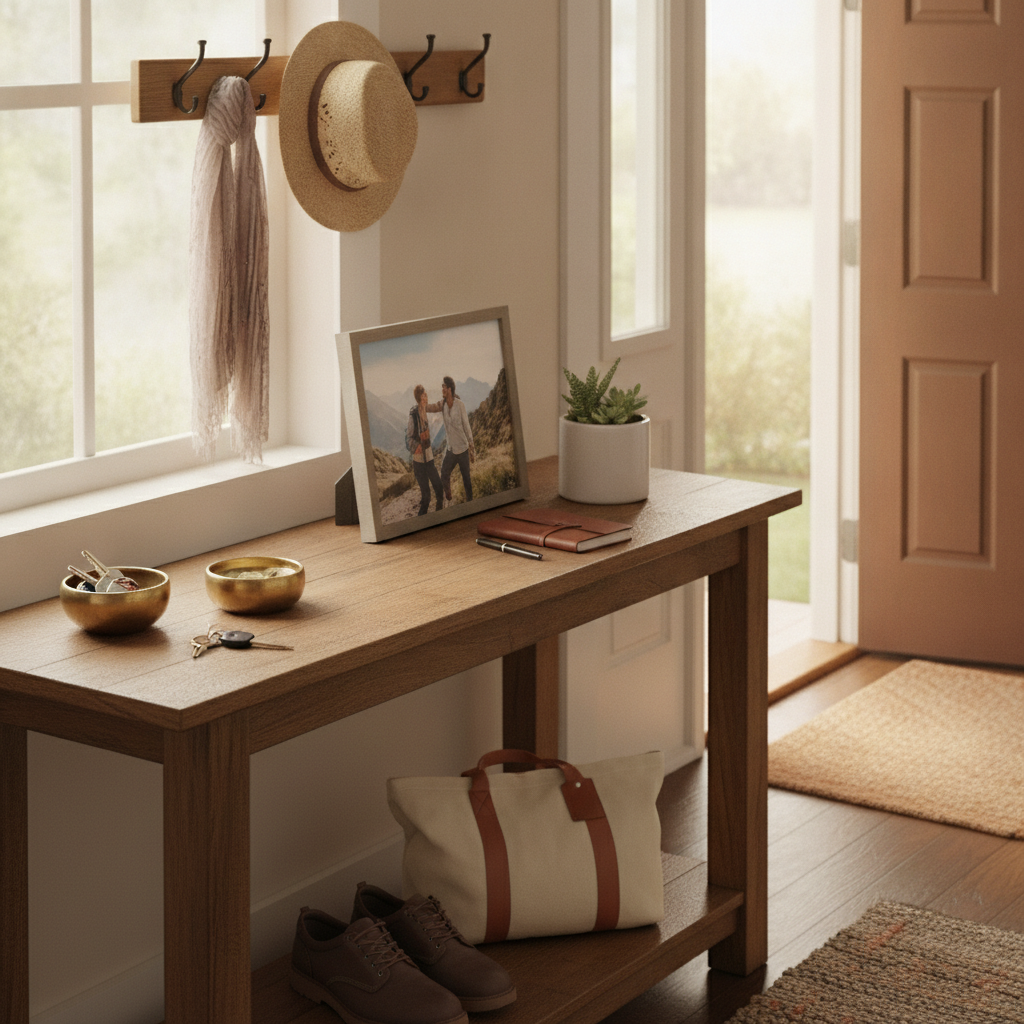
Designing an entryway with intention doesn't require renovation or significant expense. It requires something subtler: a decision about what belongs there and what the space is meant to communicate. In the interior design world, practitioners who work in the tradition of *wabi-sabi* — the Japanese aesthetic that finds beauty in imperfection and impermanence — often recommend entryways that hold only what is used and loved, with nothing excess, nothing performative. A single small tray for keys. One coat hook per household member. A plant, perhaps, or a small framed image that carries personal meaning. The goal isn't minimalism as an aesthetic performance but clarity as an emotional practice.
Brands like Muji have built entire product lines around the idea that simple, considered objects reduce friction in daily life, and their entryway storage pieces — low-profile shelving units, narrow shoe racks, wall-mounted hooks — are designed precisely for this transitional function. The underlying argument is persuasive: when the objects in a departure space are organized, visible, and purposeful, the act of leaving becomes easier. A person doesn't hunt for keys, doesn't feel the latent guilt of a pile they haven't addressed, doesn't begin their commute already carrying the weight of domestic disorder.
The Objects That Anchor a Positive Departure
Beyond organization, there's a more nuanced layer to this — the role of specific meaningful objects in establishing an emotional tone. In many Latin American households, a small *retablo* or devotional image near the door serves as a point of quiet acknowledgment before leaving, a moment of grounding that requires nothing more than a glance. In parts of the Middle East and South Asia, a hand of Fatima or *hamsa* near the entry holds both protective symbolism and daily visual significance. These aren't merely decorative customs; they reflect an understanding that the departure moment benefits from an anchor, something that orients a person before the day's demands arrive.
For those without a cultural tradition that specifies what that anchor should be, the choice becomes personal. Some people find a framed photograph of a meaningful place — the coastline near Cape Town, a market lane in Oaxaca, a childhood garden — offers a moment of quiet perspective before stepping out. Others keep a single meaningful object on a small shelf: a worn stone from a significant trip, a piece of pottery from a maker's market in Portland or Ghent. The object itself matters less than the quality of attention it invites, that brief pause that says: before you go, remember what you value.
Building Your Own Departure Ritual
For you, the question worth sitting with isn't how to make your entryway look a certain way but what it currently communicates. Stand near your front door and spend a moment with it honestly. Does the space feel held and intentional, or does it feel like the place where things end up? Is there something near that door that genuinely pleases you, that you chose rather than accumulated? The shift from reactive accumulation to considered placement is small but its effects travel with you.
Consider removing anything that isn't used daily or that carries a sense of unresolved obligation. Add something modest that holds visual warmth — a small ceramic object, a plant that tolerates low light, even a single hook that holds only what you actually reach for. Entryway apps and home organization platforms like Houzz offer visual reference for how even narrow or awkward spaces can be made to feel purposeful without significant investment. The practice isn't about aesthetics for their own sake; it's about recognizing that the quality of how you leave home quietly shapes the quality of what you carry with you into the day.
The texture of every departure begins long before the door closes. It begins in the objects that hold the space, in the visual message sent in that final interior moment. A front entry treated with even modest intention becomes something more than a passageway — it becomes a small, daily act of self-regard, a space that reminds a person, before the world begins its demands, of who they are and what they're stepping out to meet.