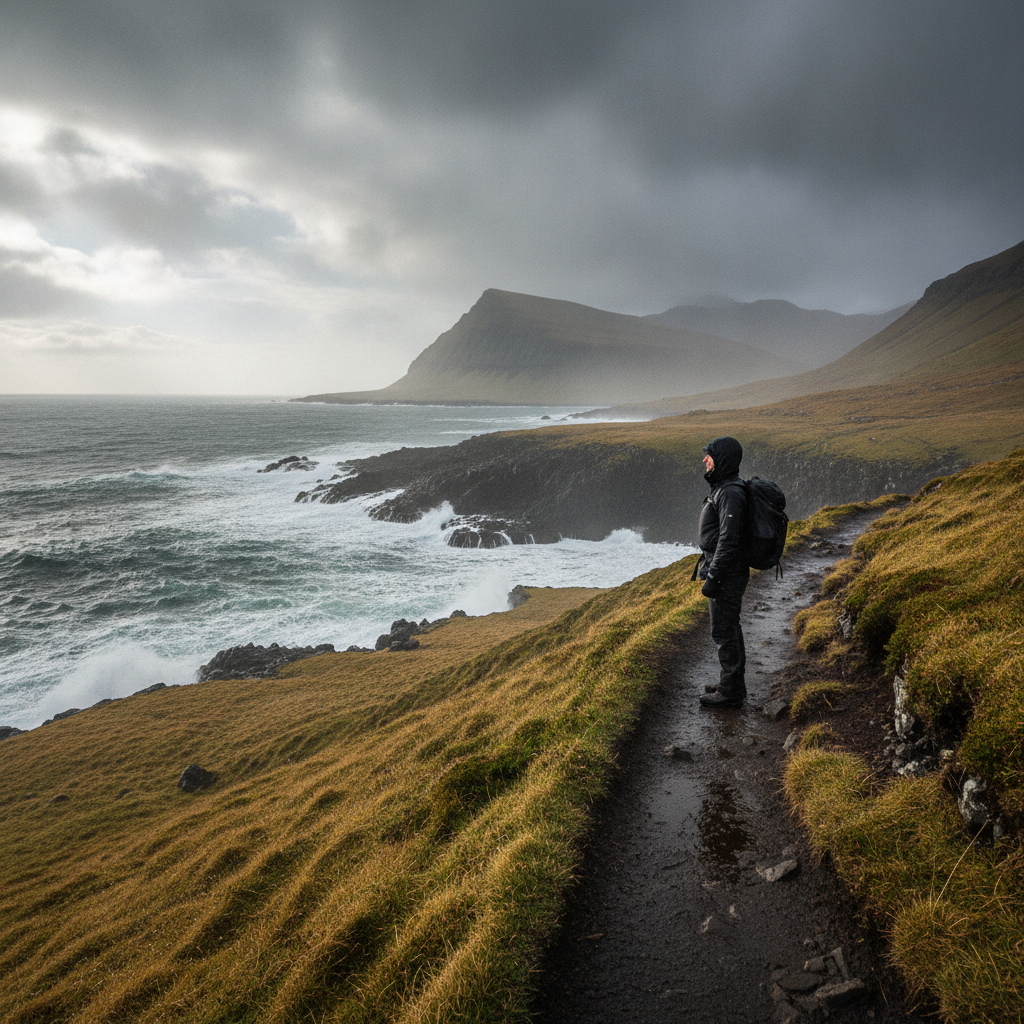
Some places insist on being experienced on their own terms, and the Faroe Islands are among the most insistent of all. This remote North Atlantic archipelago, wedged between Norway and Iceland, doesn't offer the kind of weather a traveler can negotiate with, predict with much confidence, or work around by choosing the right jacket. November, in particular, strips away any illusion of control. Within a single afternoon, conditions can move from soft, grey stillness to sideways rain to a window of luminous gold light so brief it feels almost imagined. Travelers who arrive expecting to manage the Faroe Islands soon discover that the islands have entirely different plans.
Weather as a Primary Travel Companion
The Faroese have a word — *veðrið* — that functions less as a forecast and more as an ongoing conversation. It refers to the weather not as a condition to endure but as something perpetually in motion, worth watching and respecting. Locals check the sky not to plan around it but to stay attuned to it, adjusting their day with a naturalness that takes visitors some time to absorb. November brings some of the archipelago's most dramatic shifts: storm fronts rolling in from the North Atlantic, fleeting clearings over Sørvágsvatn lake, mornings where Tórshavn's coloured-rooftop harbour sits wrapped in a mist so thick the water seems to disappear entirely. For the traveler conditioned to scheduling around weather apps, this is disorienting at first and quietly liberating by the end of the week.
The practical effect is that a fixed itinerary becomes almost useless. A plan to drive the winding coastal road to Gásadalur might be postponed twice before conditions finally cooperate — and when they do, the clarity after a storm makes the waterfall and the cliffside views feel earned in a way that a calm, scheduled visit never quite could. Travelers who hold their plans loosely tend to find that November rewards them with moments of extraordinary beauty; those who resist the flexibility often feel the trip has failed them, when really it's the expectations that have failed, not the islands.
What Faroese Culture Reveals About Patience
The Faroese relationship with weather isn't just practical — it runs through the culture in ways that become visible the longer a visitor stays. *Heimablídni*, a tradition of welcoming guests into private homes for meals, is often described as an expression of warmth against an inhospitable exterior world. It's no coincidence that this kind of intimacy developed in a place where the outdoors can turn hostile without warning. The communal meal, the slow conversation, the willingness to sit with uncertainty — these aren't just social customs but adaptive strategies refined over centuries of living beside the Atlantic.
Visitors who spend time in local guesthouses or smaller villages, rather than concentrating only on the well-documented viewpoints, tend to notice this quality more acutely. There's a collective composure to daily life that has less to do with stoicism and more to do with a deeply practised acceptance. Weather isn't a disruption; it's the baseline condition around which everything else is organised. That reorientation — from weather as obstacle to weather as fact — is one of the more significant internal shifts a November trip to the Faroes tends to produce.
Learning to Travel in the Present Tense
November in the Faroe Islands teaches something that's difficult to learn from a guidebook: the value of being fully present in uncertain conditions rather than waiting for the moment to become convenient. The island of Streymoy, for instance, offers some of the archipelago's most compelling walking trails, but those trails in November are wet, unpredictable, and occasionally treacherous in ways that demand full attention. There's no room for distraction. The body and mind orient toward the immediate — the placement of a foot, the shift in wind direction, the sudden brightness when clouds part over the sea far below. It's the kind of attention that's difficult to manufacture at home and that travel to genuinely demanding environments tends to produce organically.
This quality of attention doesn't disappear when the traveler returns. People who have spent a week adjusting to the Faroese rhythm of stopping, reassessing, and moving only when conditions allow tend to carry something of that patience back into daily life. The relationship with uncertainty softens. Plans become proposals rather than contracts.
What the Islands Ask of You
By the time you've spent several days adjusting your schedule around something as simple as fog, the experience starts to feel less like a disruption and more like a retraining. The Faroe Islands in November ask you to release the assumption that a good trip looks like an executed plan. They ask you to find value in the afternoon spent indoors at a wool shop in Tórshavn while rain hammers the windows, in the meal eaten later than intended because the drive took longer through low cloud, in the walk abandoned halfway and tried again the next morning when the light was better than anything you'd planned for. The islands are generous with beauty, but they distribute it according to their own logic rather than the visitor's convenience. The traveler who learns to work with that logic — rather than against it — tends to leave with something more lasting than photographs. The willingness to let a place be itself, on its own schedule and in its own weather, is one of the more useful things travel can teach, and few places teach it as efficiently, or as memorably, as a grey November week on the North Atlantic's edge.