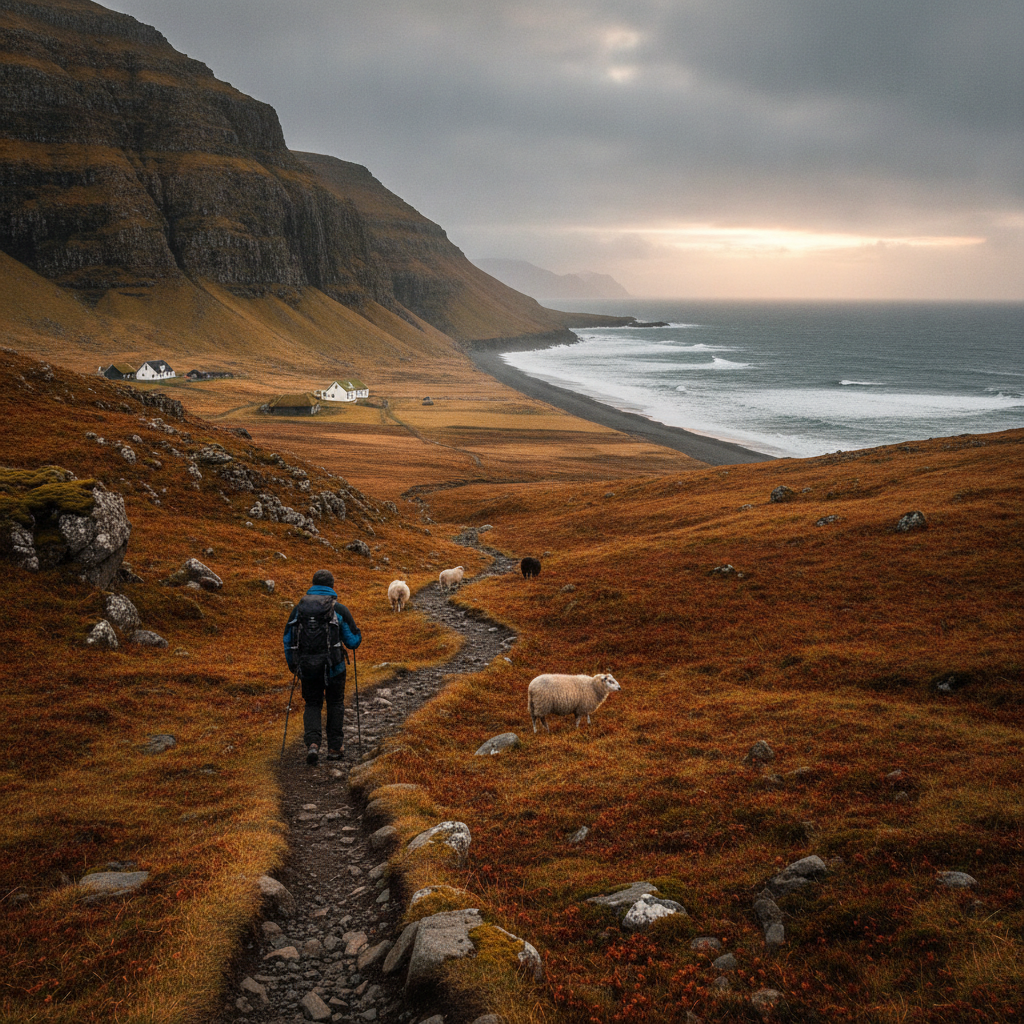
There is a particular kind of traveler who arrives somewhere expecting the landscape to perform on demand — clear skies, golden light, dramatic views appearing precisely when the camera comes out. The Faroe Islands, especially in late autumn, dismantle that expectation quietly and completely. Fog rolls in without warning, trails disappear into low cloud, and the Atlantic sends rain sideways across basalt cliffs with a kind of indifferent authority. What remains, once that expectation is released, is something more interesting: a lesson in how the rhythm of a place — not the traveler's itinerary — should govern a journey.
The Weight of an Overpacked Schedule
Most travelers, arriving in Tórshavn after a flight through Vágar Airport, arrive with an itinerary that lists Gásadalur waterfall on day one, Saksun village on day two, the sea stacks at Drangarnir by midweek. The approach is understandable — flights are expensive, time is short, and the fear of missing something famous is real. But late autumn in the Faroe Islands has a way of making that kind of scheduling feel beside the point. The archipelago operates on its own atmospheric schedule, and the weather window for any given vista might open for forty minutes or not at all. Travelers who insist on keeping a day-by-day checklist often end up frustrated, driving past closed viewpoints in dense fog while the real texture of the islands — the smell of the turf-roofed churches, the stillness of a village with no tourist infrastructure, the unhurried pace of a local ferry crossing — slips past unnoticed.
There is a Faroese concept worth holding onto here: *náttúran*, the untranslatable relationship the islanders have with their natural environment — not as backdrop or attraction, but as a living, moody presence that shapes daily life in concrete ways. Fishermen on Suðuroy don't decide to go out because the calendar says Tuesday. They read the sky, the sea, and the forecast, and they decide accordingly. A traveler who adopts even a partial version of that orientation — building in buffer days, leaving mornings unscheduled, allowing an afternoon to stretch into an unexpected conversation at a bakery in Klaksvík — tends to come away with a richer account of the place.
Reading a Destination on Its Own Terms
Pacing a trip well isn't simply about slowing down, though that's part of it. It's about building a framework flexible enough to respond to what a place is actually offering on a given day, rather than what a travel blog said it would offer in general. In the Faroe Islands, that might mean spending an entire grey afternoon in the National Museum of the Faroe Islands in Tórshavn when the original plan was a coastal hike — and discovering that the museum's collection of traditional *sjónleður* (embroidered folk textiles) offers as textured a window into island culture as any cliffside panorama. It might mean choosing the slower road between villages not because it's scenic but because the faster one is temporarily closed by a sheep drift across the asphalt, and that detour introduces a stretch of coast you wouldn't otherwise have seen.
The practical mechanism for building this kind of flexibility is deceptively simple: fewer fixed commitments per day, and a conscious decision not to fill every gap. Travelers who book a guided excursion every morning and a restaurant reservation every evening find that the trip becomes a series of appointments, logistically successful but experientially thin. Leaving two afternoons per week entirely open — with no plan beyond a general direction — creates the conditions for the kind of serendipitous pacing that makes a place feel fully inhabited rather than efficiently sampled.
The Particular Gift of Difficult Weather
Late autumn weather in the Faroe Islands is not a problem to be managed. It is, in a meaningful sense, the experience. The islands receive some of the most variable and dramatic Atlantic weather in northern Europe, and a traveler who spends time there between October and December will almost certainly encounter a full cycle — horizontal rain, sudden clearing, luminous overcast light, brief intervals of extraordinary visibility that make the surrounding ocean look almost Mediterranean in its clarity. The temptation to rate these days as good or bad based on their photographic yield misses something important.
When the weather forces a change of plan, it creates a different relationship with time. An afternoon that begins as a failed attempt to reach the Kallur lighthouse on Kalsoy might end with an hour spent in a small village café with a bowl of *skerpikjøt* soup — the Faroese fermented lamb that takes months to cure and tastes like nothing else in the world — and a slow, gestural conversation with a local about the history of the village's tidal mill. That kind of afternoon doesn't appear on any top-ten list, and it doesn't photograph well. But it tends to be the afternoon travelers remember most clearly a year later.
Bringing That Rhythm Home
If you return from a trip like this and immediately rebuild the same overpacked structure at the next destination, the lesson dissolves. The real value of traveling somewhere as deliberately uncompromising as the Faroe Islands in late autumn is the recalibration it forces — the reminder that the quality of a journey is not determined by how many named places appear in the photo archive, but by how deeply the traveler was actually present in any single one of them. Take that recalibration forward: book one fewer activity per travel day than feels comfortable, leave the mid-afternoon slot deliberately blank, and build in at least one full unhurried morning before any departure. The trip won't feel thinner for it. It will feel more like itself — and more, in the end, like the place you actually went.
The traveler who arrives in Tórshavn expecting performance and leaves having learned patience has received something the Faroe Islands give freely to anyone willing to stop scheduling long enough to receive it. That, quietly, is the whole point.