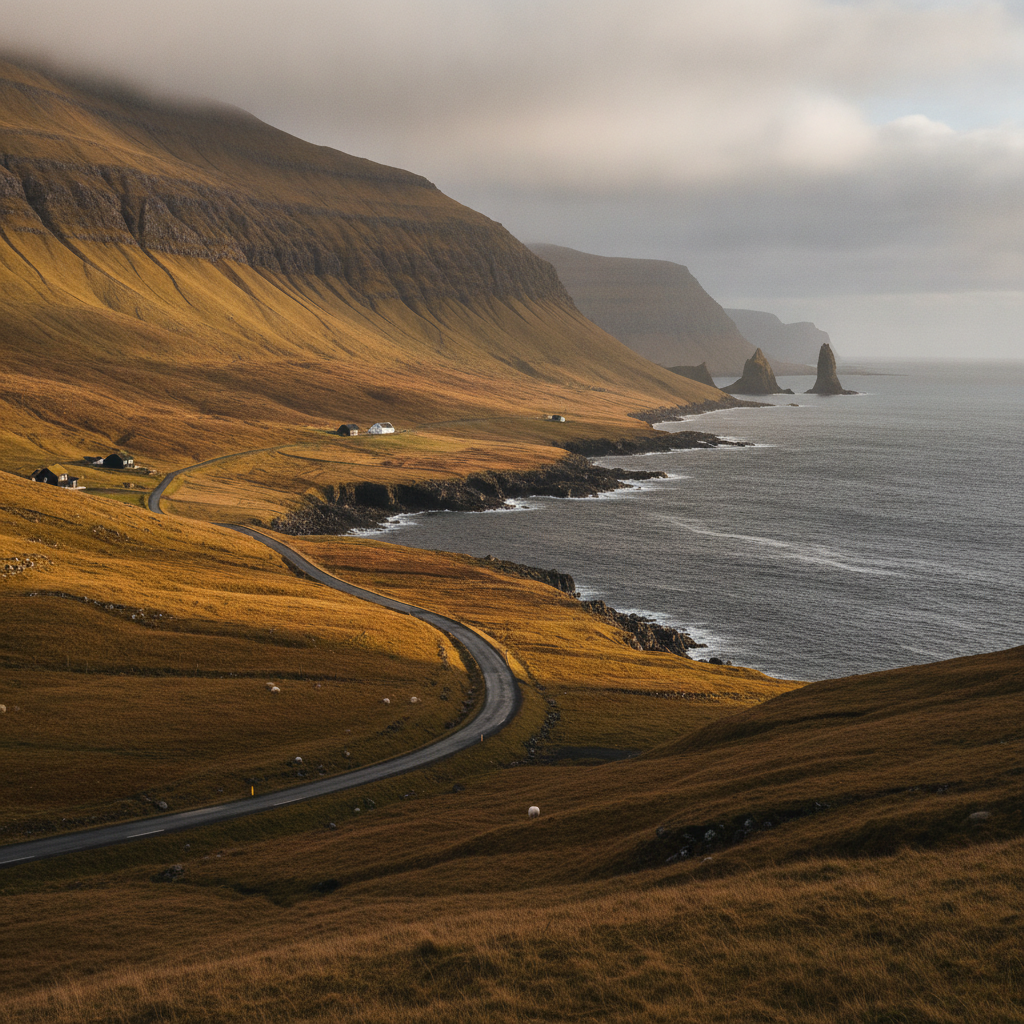
There is a particular quality to light in the North Atlantic in November — low, diffuse, and almost apologetic in the way it skims the hillsides before retreating again by mid-afternoon. The Faroe Islands, an autonomous archipelago sitting roughly halfway between Norway and Iceland, are already a place defined by dramatic contrasts: black cliffs against white water, silence broken by wind, villages so small they feel borrowed from another century. But in late autumn, when the hiking groups and summer itinerary travelers have long since departed, something shifts. The islands become more themselves. The experience changes from sightseeing to something closer to immersion, and for travelers willing to meet the season honestly, what unfolds is quietly remarkable.
The Rhythm of a Late-Autumn Day
Daylight is the governing force of any late-autumn visit to the Faroes. By November, usable light spans roughly five to six hours, with sunrise arriving well after eight in the morning and dusk settling in before three in the afternoon. This isn't a limitation so much as a structure — the day organizes itself around a narrow window of clarity, and travelers who align with that rhythm rather than resist it tend to find the experience more rewarding. Mornings are often grey and soft, with low cloud sitting on the ridgelines above villages like Gjógv and Saksun, places that in summer can feel slightly staged by their own beauty but in autumn simply exist, unhurried and largely unvisited. The compressed light also has an unexpected effect on photography: every hour of sun carries a warmth and angle that summer's long days can't replicate.
The practical side of this compressed schedule matters for planning. Driving the main road network, which connects the larger islands via tunnel and causeway, becomes essential rather than optional. The undersea tunnel linking Streymoy to Eysturoy and the remarkable Eysturoyartunnilin — a subsea roundabout opened a few years ago and still one of the more surreal driving experiences in northern Europe — means island-hopping happens without ferries in most cases. Late autumn brings fewer tunnel delays, faster border crossings between islands, and the particular satisfaction of arriving somewhere before anyone else does that day.
What the Villages Actually Look Like Without Summer
Kirkjubøur, on the southern tip of Streymoy, holds one of the oldest surviving wooden farmhouses in the world — a structure called Roykstovan, still inhabited by the same family that has lived there for centuries. In summer, small tour groups pass through regularly, guided by context they've read in advance. In late autumn, the site settles back into its natural state, which is to say it looks exactly like what it is: an old farm on a windy shore, with a ruined cathedral nearby and sheep grazing between the stones. The absence of interpretive infrastructure forces a slower kind of attention. Travelers without a guided narrative tend to linger longer, look more carefully, and leave with a more layered impression than a curated visit sometimes allows.
The village of Tórshavn — the Faroese capital, and by any global measure a remarkably small one — reveals itself differently in the off-season as well. The old town quarter known as Tinganes, a cluster of turf-roofed government buildings extending into the harbor on a small peninsula, is one of the oldest continuously governed sites in the Norse world. In late autumn, locals walk through it on their way to and from the harbor without particular ceremony. The coffeehouse near the main square, Kaffihúsið, stays open through the quieter months and becomes the kind of place where a traveler can sit for two hours watching the weather change over the water without feeling any pressure to move on.
Faroese Culture and the Value of Slowing Down
The Faroese concept of *trøllabinding* — the deep-rooted tradition of textile craft, particularly knitting with distinctive local patterns — is more visible in autumn than in any other season. Wool goods appear in small shops and market stalls as the weather turns practical rather than decorative, and the patterns themselves carry meaning rooted in the specific geography of individual islands. A traveler who takes the time to ask about these distinctions, perhaps at one of the small craft producers outside Tórshavn, tends to walk away with something more than a purchase. The conversation that accompanies a well-made thing is part of what makes off-season travel in smaller, less tourist-dependent destinations feel genuinely reciprocal rather than extractive.
Food in late autumn leans into what the Faroes have always done with their environment: fermented lamb known as *skerpikjøt*, dried fish, and hearty root-based dishes that make sense of the season rather than apologize for it. The restaurant Ræst, which takes its name from the Faroese word for a specific fermentation process applied to meat and fish, offers a menu that reads as a direct translation of the climate and landscape. Eating there in November, when the wind is audible through the windows and the harbor lights are already on by four in the afternoon, is a different experience than the same meal in July. Context isn't everything, but in the Faroes, it comes close.
What You'll Actually Need to Bring
Late autumn in the Faroes demands honesty about gear, but not excess. Waterproof outer layers are non-negotiable — the islands average rain on a significant majority of days year-round, and late autumn is no exception. Merino mid-layers perform better than synthetic alternatives in the damp cold, staying warm even when moisture is present. Footwear with genuine ankle support matters for any walking beyond paved surfaces, since the grass paths connecting farms and viewpoints become slippery and uneven after rain. A good headlamp extends the usable day in either direction. Beyond those essentials, the common mistake is overpacking for conditions that are demanding but not extreme — temperatures hover above freezing through most of November, and the wind, while persistent, is rarely dangerous at lower elevations.
For the traveler who arrives in the Faroe Islands in late autumn without the summer crowd, the experience begins in the same grey, windswept light that opened the journey — low on the hillsides, honest about what it is, asking nothing more than a willingness to look slowly and stay a little longer than planned. The islands don't perform for an off-season visitor. They simply continue, as they always have, and that continuity turns out to be the most valuable thing they offer.