Every experienced traveler eventually encounters a destination that exposes the gap between what they thought they needed and what actually matters. The Faroe Islands in late autumn is one of those places — a remote North Atlantic archipelago where the weather changes four times before lunch, the wind can make an expensive shell jacket feel almost irrelevant, and the locals move through the landscape with an ease that quietly humiliates the heavily loaded visitor. What happens there isn't just a lesson in packing efficiency. It's a recalibration of how travelers think about preparation altogether.
The Weight of Assumed Conditions
Most people planning a late-autumn trip to the Faroes arrive with mental images drawn from outdoor gear catalogs: layered technical systems, waterproof-everything, poles, gaiters, and enough redundancy for a polar expedition. The islands encourage this thinking, given that Tórshavn — the small, impossibly scenic capital — registers as one of the cloudiest and windiest places in Europe on average. What the catalogs don't show is how frequently the rain arrives horizontally, rendering standard rain hoods nearly useless, or how quickly conditions shift from driving fog to clear gold light within the same hour. Travelers loaded with gear for every possible condition often find themselves switching between layers at such frequency that the system becomes its own source of exhaustion. The weight of prepared answers to weather that hasn't yet arrived is a particular kind of inefficiency.
What Faroese Layering Culture Actually Looks Like
The Faroese concept of *náttúrusamband* — a deep, unforced relationship with nature — shapes how islanders dress and move outdoors. They don't typically pile on technical gear because they've grown up reading conditions rather than defending against them. A heavy wool sweater, often hand-knitted in the traditional Faroese style, does more practical work in the island's damp cold than many four-layer synthetic systems costing ten times as much. Brands like Devold and Ulvang have built entire product lines around this principle, and serious visitors do well to pay attention. The broader takeaway isn't that synthetics are wrong — it's that travelers frequently choose gear based on marketing language rather than actual use conditions. A mid-weight merino base, a reliable wind shell, and one genuinely waterproof outer layer handle the Faroes across almost any late-autumn day. Everything beyond that tends to occupy bag space without earning its place.
The Carry Problem on Faroese Terrain
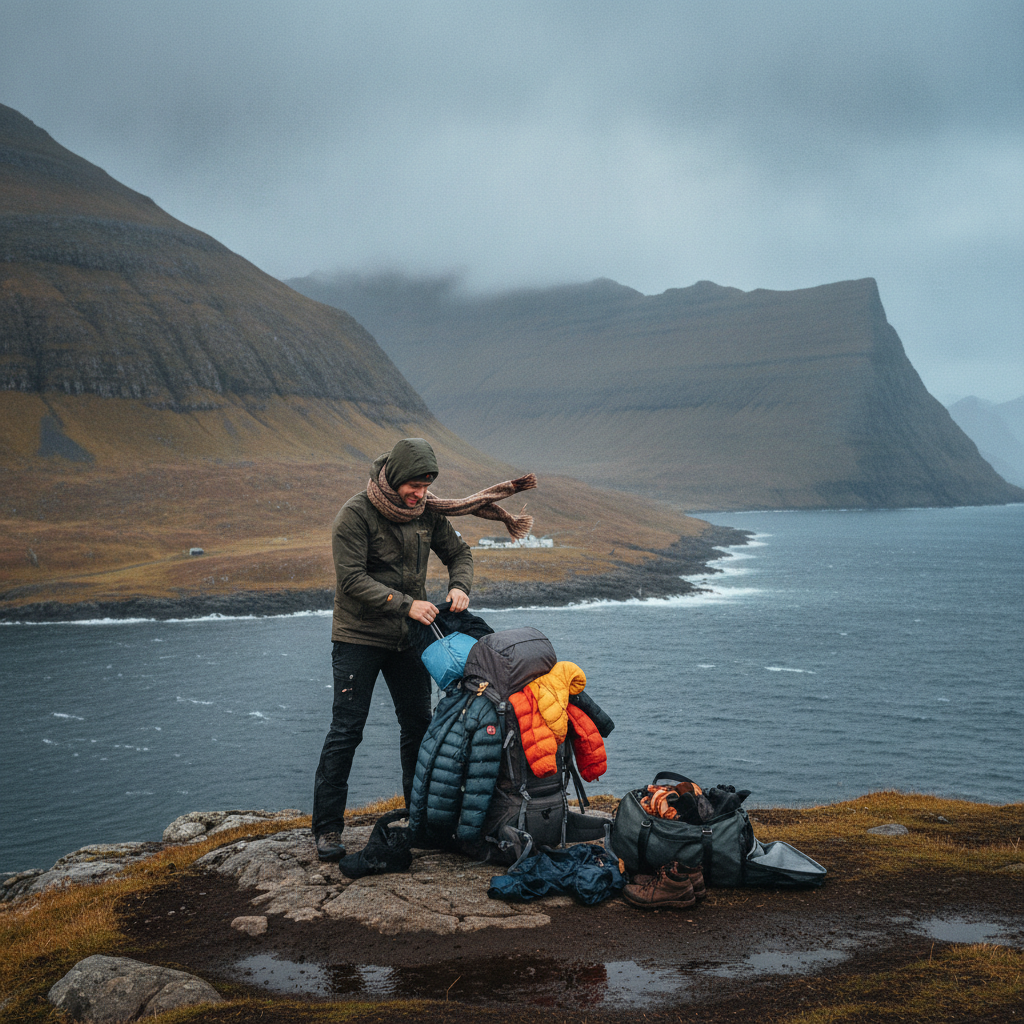
The Faroes are geographically compact but physically demanding. Short trails like the descent to Saksun or the ridge walk above Gásadalur involve steep, boggy ground, narrow passes, and the kind of footing that shifts constantly underfoot. On terrain like this, what a traveler carries becomes immediately measurable — not in kilograms on a luggage scale, but in fatigue, balance, and attention. A bag that felt manageable at the trailhead starts to pull at the shoulders on a twenty-degree incline into coastal wind. Hikers frequently discover that the accessories they packed as backup — the extra boot waterproofing spray, the secondary rain cover, the full-sized tripod for landscape photography — are not just unused but actively disruptive to movement. Traveling light in the Faroes is less about minimalism as philosophy and more about respecting what the landscape asks of a person physically.
Reading What You Actually Reach For
One of the quieter revelations of a Faroese trip is how quickly a traveler's actual usage pattern becomes visible against the backdrop of limited mobility. When accommodations are small guesthouses in villages like Gjógv or Eiði, and when the nearest gear shop is a ferry ride away, the contents of a bag stop being theoretical. Travelers start noticing which items they reach for every day and which ones haven't been touched since the airport. A good headlamp earns its place immediately in the long northern darkness. A second pair of waterproof gloves proves its worth on the third day of rain. The third fleece mid-layer, the packable pillow, the portable espresso kit — these tend to sit in the bottom of the bag accumulating the mild guilt of good intentions. The Faroes have a way of making that accounting honest without being cruel about it.
The Discipline That Comes After
When you return from a place like the Faroe Islands, the experience of what went unused doesn't leave quickly. Packing for the next trip becomes a different kind of exercise — less about covering every possibility and more about identifying what genuinely pulls its weight. Travelers who have spent time in the Faroes often describe a lasting shift in how they assess gear before a trip: they hold each item against the question of whether it solved a real problem on the last journey, rather than a hypothetical one on the next. Apps like PackPoint can help structure this thinking, but the deeper recalibration is less about tools and more about honesty. The Faroe Islands, for all their dramatic beauty and unpredictable weather, ultimately teach the same lesson as every demanding destination: that thoughtful preparation is almost always lighter than anxious preparation.
There is something in the North Atlantic air — in the particular silence between wind gusts above Trælanípa, or the strange warmth of a *heimablíðni* dinner shared in a stranger's farmhouse kitchen — that resets the traveler's relationship to their own belongings. The islands are not gentle teachers, but they are clear ones. What you carry matters less than why you carried it, and the gap between those two questions is where most overpacking quietly lives. Returning from the Faroes, a traveler doesn't just know what to leave behind on the next trip. They understand, at a slightly deeper level, why they packed it in the first place — and that understanding turns out to be worth more than anything they left in the guesthouse room.