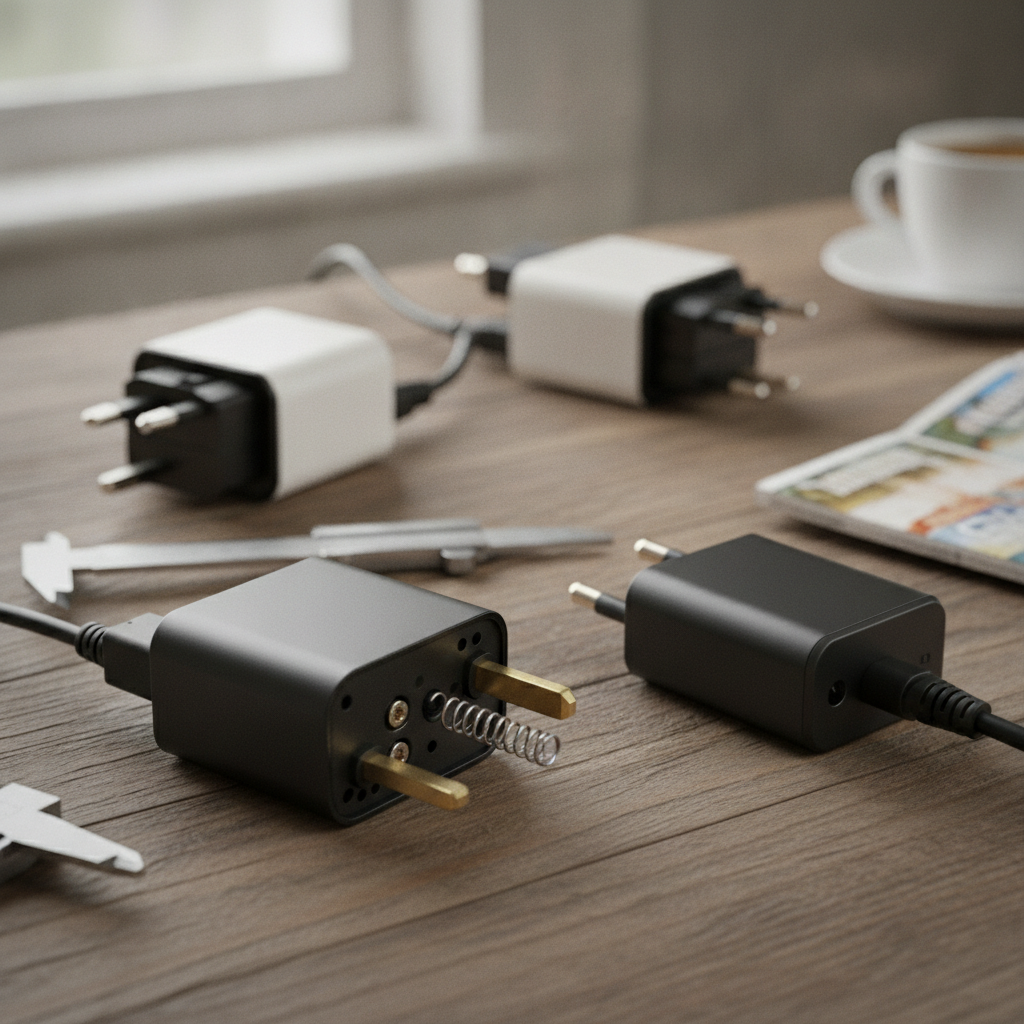
Most travelers shopping for a universal adapter spend their time counting plug configurations and comparing price tags, but the number of country symbols printed on the packaging says almost nothing about how well an adapter will actually perform under real travel conditions. The detail that separates a reliable adapter from a frustrating one lives inside the manufacturing tolerances — the precision with which contact pins are machined, the quality of the spring mechanisms, and the consistency of the electrical pathway from input to output. Treating plug count as the primary buying signal routinely leads travelers to products that feel fine in a store but fail on the road.
Why Does Plug Count Mislead Buyers?
Universal adapters with twenty or thirty plug configurations photograph well and look impressive on product listings, but adding more retractable plug types to a single housing introduces real engineering tradeoffs. Each additional configuration means more moving parts, more compression springs, and more potential points of mechanical failure. Manufacturers working at lower price points frequently achieve high plug counts by using thinner pin stock and looser spring tension, which reduces production cost but also reduces the firm, consistent contact needed to hold a plug securely in an international wall socket. A four-configuration adapter built to tight mechanical tolerances will almost always outperform a thirty-configuration adapter that isn't.
What Do Build Tolerances Actually Mean in Practice?
Build tolerance refers to how precisely a manufactured component matches its intended specification — in an adapter, this shows up most clearly in how the contact pins seat against the socket wall and how much lateral movement exists when the adapter is plugged in. A well-toleranced adapter sits flush and still; a poorly toleranced one wiggles, which creates intermittent electrical contact and, over time, heat at the connection point. Brands like Zendure and Epicka have built recognizable reputations partly by maintaining tighter tolerances on their pin assemblies, which is why experienced travelers frequently recommend them regardless of whether they cover the widest range of destinations.
How Can You Assess Tolerances Before Purchasing?
When examining an adapter in person, the most informative test is extending each plug configuration and pressing it laterally with a finger. There should be minimal flex — the pin assembly should feel rigid and locked. Any noticeable wobble under light finger pressure suggests the retaining mechanism or the pin stock itself is underbuilt. For online purchases, the same principle translates into reading reviews specifically for language around "loose fit," "wobble," or "gets warm." Product listings from retailers like B&H Photo or REI often attract more technically detailed reviews than general marketplaces, which gives a clearer picture of real-world mechanical performance before buying.
What Electrical Ratings Reveal About Internal Quality?
The surge protection and maximum amperage ratings printed on an adapter are a secondary but meaningful signal of internal build quality. An adapter rated for 6A or higher with a properly specified surge suppressor has, by necessity, used heavier gauge internal wiring and more robust contact surfaces to handle that load safely. Adapters with vague or missing electrical ratings, or ones that list only voltage compatibility without specifying current, are frequently built with thinner internal conductors that technically function but degrade more quickly under the heat generated by laptops, phone chargers, and other modern travel electronics running simultaneously. The rating isn't a marketing number — it reflects a real engineering commitment.
How Does Housing Material Affect Long-Term Reliability?
The outer casing of an adapter matters more than cosmetics suggest. Polycarbonate housings with a matte texture and visible wall thickness at the socket openings indicate a manufacturer investing in structural integrity; thin, glossy housings with shallow socket walls tend to crack under repeated plug insertion cycles, particularly in climates with temperature swings. Adapters from Skross, a Swiss brand with a strong reputation for component quality, routinely use reinforced housings with recessed socket openings that resist edge cracking even after years of use. Running a thumbnail along the socket edge of any adapter should reveal whether the plastic has meaningful thickness or is closer to a thin shell.
What Should You Actually Check Before Buying?
Before committing to a travel adapter purchase, you can run through a short but effective evaluation checklist. First, identify the specific outlet types for your destination — most itineraries need only two or three configurations, so a tightly built focused adapter beats a sprawling universal one. Second, check the amperage rating on the product spec sheet, not just the box art, and confirm it meets or exceeds the combined draw of your devices. Third, look for reviews that mention fit quality in specific countries like the UK or South Africa, where socket tolerances are tighter and a loose adapter will arc or overheat. Finally, treat any adapter without a clearly printed surge rating as a device meant for occasional light use, not daily charging of multiple devices across a long trip.
Choosing a travel adapter by build quality rather than feature count is a small habit shift that pays off considerably over time. A well-constructed adapter bought once — and evaluated carefully before purchase — will outlast several cheap alternatives and keep devices charging reliably whether the outlet is in a Lisbon guesthouse or a transit hotel near Bangkok's Suvarnabhumi Airport. Take a few minutes to check the tolerances, read the spec sheet, and match the adapter to your actual destinations. That short investment of attention before you buy makes everything else on the road a little smoother.