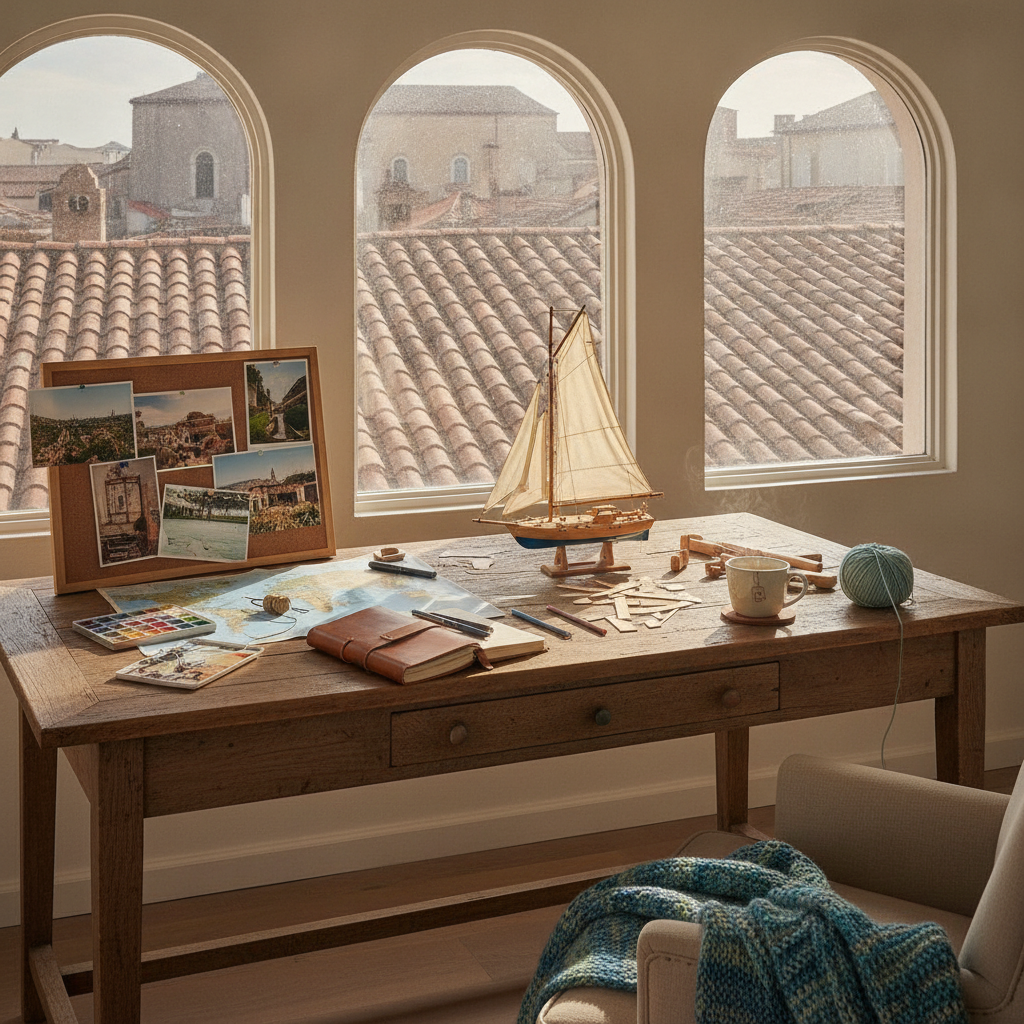
Most unfinished projects don't die from lack of interest — they die from friction. The moment a half-completed task gets tucked into a drawer, stacked under other things, or mentally filed as "I'll get back to that," its odds of completion drop significantly. Physical space and psychological momentum are more connected than most people realize, and the simple act of giving an in-progress project a permanent, visible home changes the entire relationship between a person and the work they're trying to do.
The Psychology Behind Visible Work
When something is out of sight, it's rarely just out of mind — it's out of the behavioral loop entirely. Research into habit formation has long established that visual cues are among the most reliable triggers for continued action. A half-knitted scarf left on the coffee table, a sketchbook open on a dedicated desk corner, a repair project staged on a workshop shelf — each functions as a quiet prompt that keeps intention alive. Without that cue, the project exists only in memory, competing with every other obligation and distraction that fills a typical day. Visibility converts intention into momentum.
How Physical Setup Reduces Decision Fatigue
One of the quieter costs of incomplete projects is the low-grade mental effort of repeatedly re-deciding to return to them. Every time someone remembers a stalled task, they face a micro-decision: do it now, or defer again? Without a dedicated space, that cycle repeats indefinitely. When a project has its own spot — a basket, a tray, a corner of a worktable — the decision is already made. The setup itself communicates that the work is ongoing, not abandoned. Apps like Notion or Trello attempt to replicate this logic digitally, but for physical projects, the real-world equivalent of an assigned space works more reliably.
The Role of Low-Barrier Re-Entry in Creative Work
Creative and craft projects are especially vulnerable to stalling because they often require a specific mental mode to engage with meaningfully. The higher the barrier to re-entry — the more things that need to be gathered, cleared, or remembered — the easier it becomes to skip a session entirely. Studios like Creativebug and craft educators consistently emphasize that keeping materials staged and ready reduces the activation energy required to begin. A dedicated project spot effectively pre-loads the environment so that sitting down is the only step required. That single reduction in friction can be the difference between a project that progresses and one that quietly expires.
What Unfinished Projects Actually Cost
Beyond the obvious frustration of accumulating incomplete work, unfinished projects carry a less visible cost: they occupy cognitive bandwidth. Psychologists refer to this as the Zeigarnik effect — the tendency for incomplete tasks to demand more mental attention than completed ones. Multiply that across three or four stalled projects, and the cognitive load becomes meaningful. A dedicated project space doesn't just help with completion rates; it also clarifies the full picture of what's actually in progress. Seeing everything laid out in one place makes it easier to decide what to prioritize, what to abandon intentionally, and what genuinely deserves continued effort.
Designing a Project Space That Actually Works
The most effective dedicated project spaces share a few consistent qualities: they're specific enough to contain only active work, accessible enough to require no setup, and positioned where they'll be seen regularly. A rolling cart in a living area, a shallow tray on a bookshelf, or a pegboard corner in a garage can each serve this function depending on the type of project. The key is that the space belongs to in-progress work only — not to finished items, supplies waiting for future projects, or general clutter. Retailers like IKEA and The Container Store offer practical systems designed exactly for this kind of staged organization, though the system matters far less than the discipline of maintaining its purpose.
Building the Habit of Returning
Having the space is the structural piece; returning to it consistently is the behavioral one. For most people, the best approach isn't scheduling rigid project sessions but rather lowering the expectation of how much needs to happen each time. Even ten minutes of progress on a visible, accessible project is enough to sustain momentum. Here's where the shift becomes personal: you don't need a perfectly organized studio or an elaborate system to make this work. Start with one project, one surface, and one rule — that surface is only for active work. Clear it when the project is done. Then start the next one. The habit builds from the structure, not the other way around, and over time, finishing becomes less of a deliberate effort and more of a natural result of having set things up correctly from the start.
The relationship between physical environment and follow-through is one of those dynamics that reveals itself gradually. A dedicated spot for in-progress work doesn't force completion — it removes the conditions that make abandonment so easy. Projects that remain visible, accessible, and staged tend to get finished not because people suddenly become more disciplined, but because the environment quietly makes continuing the path of least resistance.