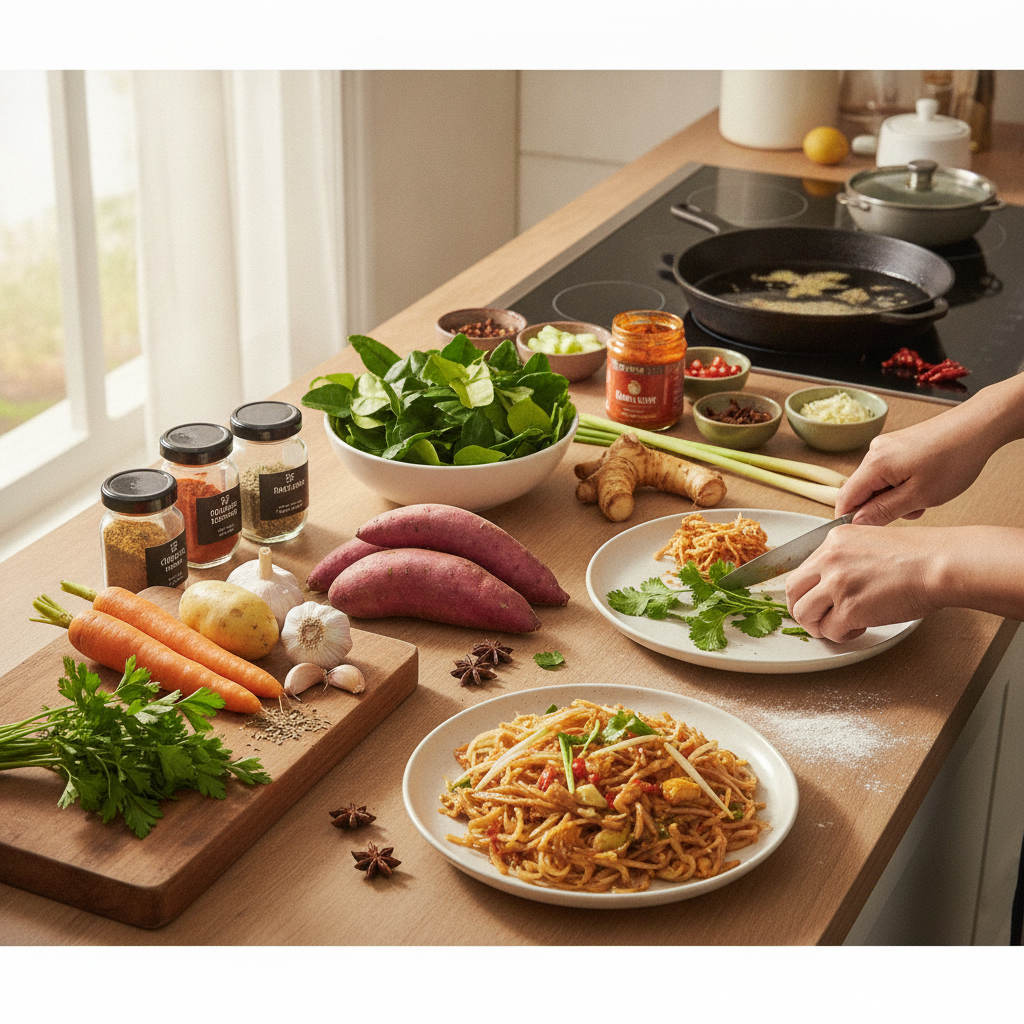
The pantry most people own is far more versatile than they realize. The same jar of cumin that seasons a weeknight taco might, with a slight shift in perspective, anchor a Moroccan chermoula or form the backbone of an Indian dal. What keeps most cooks from discovering this is not a lack of ingredients — it's a lack of context. Introducing one unfamiliar cuisine each month provides exactly that context, and over time, it reshapes the mental map that governs how ingredients are seen, combined, and valued.
Recognize That Every Cuisine Teaches a Different Logic
Cooking is a system of relationships, not a list of recipes. Japanese cuisine, for instance, operates on the concept of *umami* — a savory depth achieved through ingredients like miso, kombu, and bonito — which encourages cooks to think about flavor as layered and cumulative rather than direct. When someone engages seriously with Japanese home cooking, even for a single month, they start noticing that a splash of soy sauce in an otherwise Western dish does something structurally similar. The logic transfers. That's the quiet mechanism at work: learning one cuisine's internal rules makes the rules of other cuisines — including your own defaults — far more legible.
Start With a Cuisine That Shares Some Pantry Overlap
Beginners often make the mistake of choosing the most exotic-sounding option available, then feeling discouraged when a specialty ingredient proves impossible to source. A more sustainable approach is to begin with cuisines that share at least partial overlap with what's already in the kitchen. Persian cooking, for example, draws heavily on dried fruits, walnuts, herbs, and saffron — ingredients that many home cooks already have in some form. Starting at a point of partial familiarity makes the unfamiliar elements feel like additions rather than replacements, which lowers the psychological barrier to trying and repeating the experiment the following month.
Let One Technique Change How You Use a Familiar Ingredient
One of the most striking moments in this kind of monthly practice is when a familiar ingredient behaves in an entirely unexpected way. Chickpeas, for instance, are a common pantry staple in many Western households, usually roasted or added to salads. In Ethiopian cooking, they appear ground into flour for *shiro* — a deeply spiced, slow-cooked sauce that tastes almost nothing like anything the same legume typically produces. Encountering that transformation doesn't just expand the recipe repertoire; it fundamentally changes how chickpeas are perceived going forward. They stop being a single-use item and become something with range. That shift in perception is worth more than any individual recipe.
Build a Small Reference Collection to Ground Each Month's Exploration
Random recipe browsing can produce results, but a more reliable approach involves anchoring each monthly exploration in a single, well-regarded source. Cookbooks like *Jerusalem* by Yotam Ottolenghi and Sami Tamimi, or Madhur Jaffrey's *An Invitation to Indian Cooking*, offer cultural grounding alongside recipes — they explain *why* certain ingredients behave as they do within a tradition, not just *what* to do with them. Even a trusted food publication like Serious Eats or a dedicated channel on YouTube can serve the same orienting function. Having one trustworthy reference per cuisine ensures the learning goes deeper than surface-level novelty, which is what makes the rewiring stick.
Notice What Each Cuisine Treats as Essential Versus Optional
Every culinary tradition draws a quiet hierarchy between essential components and optional embellishments. In Korean cooking, the fermented paste *doenjang* — a close cousin to Japanese miso but earthier and more pungent — is treated as foundational rather than decorative. In French *cuisine bourgeoise*, a well-made stock is considered non-negotiable in a way that shortcuts cannot replicate. Paying attention to what each tradition refuses to skip teaches something broader: that certain ingredients carry structural weight in a dish rather than merely contributing flavor. Once that idea takes root, a cook starts evaluating their own pantry differently, asking not just what tastes good but what does essential work.
Track the Moments When Old Ingredients Appear in New Contexts
A useful habit during this monthly practice is keeping a loose record — a notebook, a notes app, even a few voice memos — of moments when an ingredient from one cuisine unexpectedly appears in another. Tamarind shows up in Mexican agua fresca, West African stews, and Tamil Nadu chutneys. Fennel seeds anchor Italian sausage, Indian *chai* spice blends, and Scandinavian rye breads. Documenting these intersections builds a kind of personal ingredient atlas, one that gradually reveals the underlying patterns of global flavor. Apps like Paprika or even a simple shared folder of clipped recipes can help organize these observations without requiring much effort. The accumulation matters more than the format.
Let What You've Learned Change How You Shop, Not Just How You Cook
After several months of this practice, something shifts in how you move through a grocery store or farmers market. Ingredients that once seemed obscure — dried limes, black cardamom, *gochugaru* flakes — start appearing with context attached. You know what they anchor, what tradition prizes them, and roughly what they might do in a dish outside their original home. That knowledge changes purchasing decisions in a quiet but meaningful way. Instead of buying only what a single recipe demands, you begin stocking small quantities of ingredients with known range, trusting that they'll find use across multiple cuisines rather than a single occasion.
The cumulative effect of twelve months of this practice is not a dramatically different pantry or a professional-level skill set. It's something subtler and more durable: a reconfigured way of seeing ingredients as dynamic rather than fixed, as participants in multiple traditions rather than servants of one. That kind of thinking doesn't stay in the kitchen. It tends to spread into how unfamiliar situations in general are approached — with curiosity about the underlying logic rather than resistance to what's unknown. One cuisine at a time, the familiar becomes something wider.