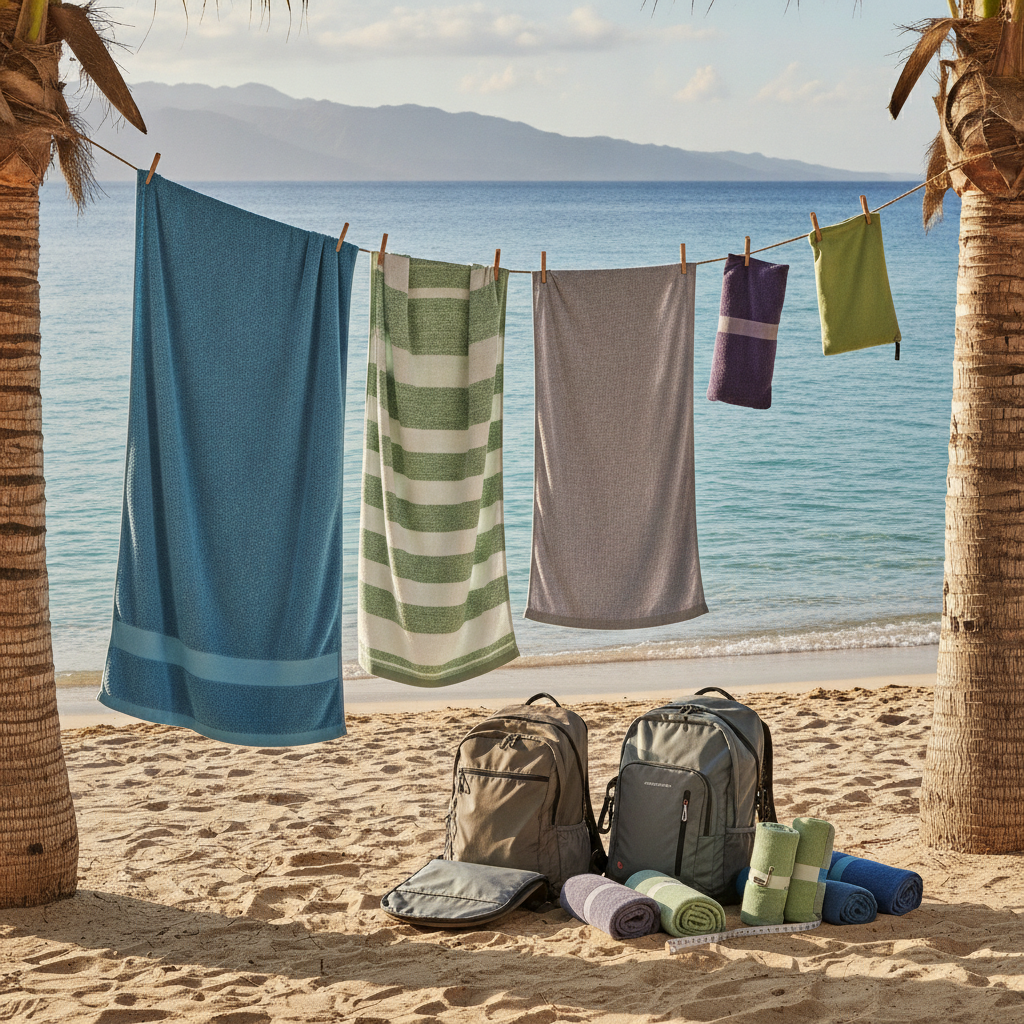
Travel towels have become one of the most aggressively marketed product categories in the outdoor and travel gear space, with brands competing loudly over claims that are difficult for shoppers to verify before purchase. The result is a buying experience driven more by packaging language than by the performance qualities that actually matter when you're moving between destinations with a damp towel and a bag that needs to close. Understanding what the materials themselves actually do — independent of brand positioning — gives travelers a much cleaner framework for comparison.
What Fiber Type Actually Determines Performance
The two dominant materials in travel towels are microfiber and bamboo-derived viscose, with a smaller market share held by merino wool blends. Microfiber, typically a polyester-polyamide blend, dries faster than any natural fiber because it absorbs water mechanically through capillary action rather than chemically bonding with moisture. This means it releases water more readily when wrung out. Bamboo viscose feels softer and has some natural antimicrobial properties, but it retains moisture longer and packs larger for the same surface area. Merino blends occupy a middle ground — slower to dry than microfiber but more odor-resistant over multiple uses without washing.
The Relationship Between GSM Weight and Dry Time
GSM — grams per square meter — is the single most useful number to find when comparing travel towels, and most brands either bury it or omit it entirely. Lower GSM means a thinner weave, which dries faster and compresses more tightly. A microfiber towel in the 200–300 GSM range will typically air-dry within an hour in moderate conditions, while one in the 400–500 GSM range may need two to three hours. The tradeoff is absorbency: lower GSM towels may require more passes to feel fully dry after a shower. Brands like PackTowl and Rainleaf publish GSM figures, which makes direct comparison straightforward — and that transparency alone is a useful signal of product confidence.
How Packed Size Translates to Real Bag Space
Marketing photos almost always show travel towels rolled neatly beside a water bottle for scale, which creates a misleading impression of compactness. The more reliable way to evaluate pack size is to find the compressed dimensions in centimeters or inches with the pouch closed. A standard bath-sized microfiber towel at 200 GSM should compress to roughly the size of a paperback book; anything larger at that weight is using less efficient weave construction. Materials also matter here: synthetic microfiber compresses more consistently than bamboo viscose or merino because it has less memory and doesn't spring back as readily. Checking seller listings on Amazon for customer-uploaded photos showing the towel beside common objects often reveals more than the official product images.
Waffle Weave Versus Flat Weave Construction
Beyond fiber type, the weave pattern significantly affects both dry time and pack efficiency. Flat-weave microfiber has a denser surface contact area, which improves absorbency but increases dry time slightly and packs less compactly. Waffle weave — used by brands like Dock & Bay — creates a grid of raised squares that reduces surface contact, accelerates air circulation across the fabric, and allows the towel to compress into a smaller volume. For travelers prioritizing speed of drying over maximum absorbency per square inch, waffle weave construction in a low-GSM microfiber fabric represents the most efficient combination available. Neither is universally superior; the choice depends on whether drying speed or absorption rate matters more for a particular trip type.
Why Sand-Resistance Claims Deserve Scrutiny
Many travel towels marketed to beach travelers include sand-resistance as a headline feature, but this claim varies widely in its real-world accuracy. Flat-weave microfiber does release dry sand more easily than terry cloth simply because it has fewer looped fibers to trap particles — but that's a structural property of microfiber generally, not a special feature of specific products. Waffle-weave towels with deeper pockets in the weave can actually hold sand more readily than flat-weave options despite similar marketing language. When evaluating sand-resistance claims, looking for independent gear reviews on sites like OutdoorGearLab or reading through Q&A sections on retail listings gives a more grounded picture than the product description itself.
Making the Final Call Based on Your Travel Pattern
Once you understand the variables, choosing the right travel towel becomes a straightforward process of matching specifications to behavior. If you're moving accommodations every day or two and air-drying in a hostel, prioritize low GSM and waffle weave construction in microfiber. If you're slow traveling with longer stays and want something that handles multiple uses between washes, a merino blend or higher-GSM bamboo viscose may suit you better despite the slower dry time. Check the compressed dimensions before you buy, find the GSM on the product page or ask the retailer directly, and treat marketing language about "ultra-fast" or "ultra-compact" as a prompt to look for the numbers behind the claim rather than a reason to trust it outright.
Travel towel marketing has outpaced the actual complexity of the product, which means shoppers who understand a small number of material properties can consistently make better decisions than those relying on brand reputation or packaging design. GSM, fiber type, and weave construction are the three variables that actually determine how a towel performs in a bag and after a shower. Keeping those factors at the center of any comparison makes it easier to find a towel that fits a real travel routine rather than an idealized one.