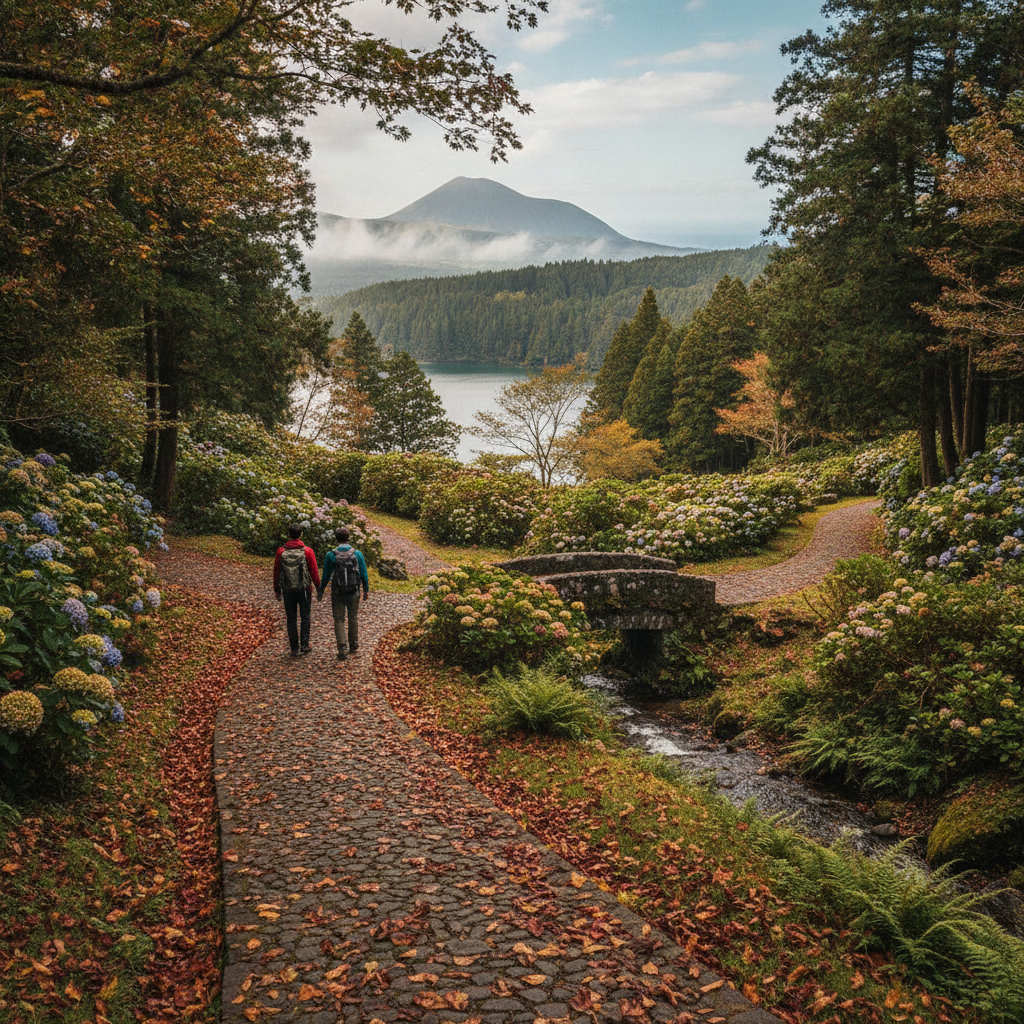
There's a particular kind of traveler who looks at a destination's peak season and quietly decides to show up a few weeks later. Not out of contrarianism, but because they've learned that the version of a place most people experience is rarely its most honest one. The Azores — that Portuguese archipelago strung across the mid-Atlantic like a loose handful of green stones — rewards this instinct more than almost anywhere else in Europe. In autumn, roughly from late September through November, the islands exhale. The summer crowds have gone home, the hydrangeas have faded to rust and amber, and what remains is something closer to the place itself.
What the Season Actually Looks Like
Autumn in the Azores doesn't arrive like autumn in northern Europe, where temperatures drop sharply and daylight shrinks fast. The islands sit in a temperate oceanic zone, which means September still feels generous — warm enough for swimming at Mosteiros or walking the volcanic coastline on São Miguel without a heavy layer. By October the air cools noticeably, and November brings more frequent rain, but even then the rainfall is intermittent rather than relentless. The light in October is extraordinary: lower in the sky, softer, hitting the crater lakes of Sete Cidades and Lagoa do Fogo at angles that summer sun never achieves. Photographers who've made the trip during both seasons tend to return in autumn on purpose.
The practical side of this seasonal shift matters too. Accommodation prices on São Miguel, Faial, and Flores typically drop meaningfully after the August peak, and availability — which can be genuinely tight in July — opens up considerably. You'll find that booking a stay at one of the region's better rural guesthouses, the kind that fills up months in advance in summer, becomes possible with just a few weeks' notice. That breathing room changes how a trip feels from the very first day of planning.
Whale Watching and the Atlantic's Autumn Rhythms
One of the Azores' most compelling draws is cetacean watching, and the season works in autumn travelers' favor here too. Sperm whales are year-round residents in these waters, but autumn brings migrating species through as well, with blue whales and fin whales appearing in higher numbers as they move along Atlantic routes. Local operators on Pico Island — the island that sits directly across the channel from Faial — run smaller group trips in shoulder season, which means less competition for space on the boats and more attentive guides. Platforms like Viator list certified operators, though booking directly through island-based companies often yields better pricing and more flexible scheduling if weather causes cancellations.
Hiking Without the Heat
Summer hiking in the Azores is manageable, but the humidity on São Miguel in July and August can make the island's interior trails feel more demanding than the elevation warrants. In October, the same routes — the caldeira rim walk on Faial, the Pico mountain ascent, the coastal paths on Flores — become genuinely pleasurable. The Pico summit trail, which requires a guide permit and pre-registration through the regional parks system, opens up appointment slots more readily in autumn. Trails that thread through laurisilva forest, a UNESCO-recognized ecosystem found on Flores and Faial, feel almost cinematic when low cloud moves through the ancient trees and there's no one else on the path.
Planning the Logistics Without Overcomplicating Them
Flights into the Azores route primarily through Ponta Delgada on São Miguel, with connections from Lisbon, Porto, and a handful of European hubs. Azores Airlines runs inter-island flights, and SATA Air Açores handles shorter hops between islands. In shoulder season, these inter-island connections run on reduced schedules compared to summer, so building a day of buffer between island hops is a practical move rather than a cautious one. Google Flights is useful for spotting price patterns across autumn dates, and setting fare alerts a couple of months out can surface genuinely good deals from Lisbon or London.
For island hopping, the ferry network operated by Atlântico Line connects several of the central group islands — Faial, Pico, São Jorge, Graciosa, and Terceira — and in autumn the seas can be rougher than summer crossings. Checking the published schedule against your travel dates matters because service frequency does decrease, and some routes operate only a few times per week outside peak season. That said, the crossings themselves, when conditions cooperate, offer views of Pico's volcanic cone rising from the water that no flight replicates.
Accommodation and Where to Stay
São Miguel handles most first-time visitors, and Ponta Delgada has a solid range of guesthouses and small hotels within walking distance of the harbor. But autumn is the right season to consider basing yourself somewhere less obvious — a rural quinta on Pico, a small inn near Fajã da Caldeira de Santo Cristo on São Jorge, or one of the converted farmhouses on Flores that open their doors to longer-stay guests. Booking platforms like Booking.com carry most of the region's inventory, but local tourism boards maintain their own listings and sometimes feature properties that don't appear on larger aggregators. A stay of five or more nights tends to unlock better rates and gives you enough time to actually settle into the pace of island life rather than rushing between sights.
Letting the Place Set the Pace
What autumn in the Azores ultimately offers is the chance to experience a place that hasn't been shaped around your visit. The restaurants in Horta on Faial serve the same grilled limpets they always have, the thermal pools at Caldeira Velha on São Miguel are just as warm, and the locals have a little more time to talk when the ferries aren't unloading tour groups every few hours. You can sit in a café in Angra do Heroísmo on Terceira — a UNESCO World Heritage town that genuinely merits that designation — and feel like you've arrived somewhere rather than passed through it. That sense of arrival, of actually landing in a place rather than grazing its surface, is exactly what the traveler who waits out peak season has been looking for all along. The Azores in autumn doesn't promise perfect weather or guaranteed whale sightings, but it offers something harder to manufacture: the real texture of islands that have been quietly spectacular for a very long time.