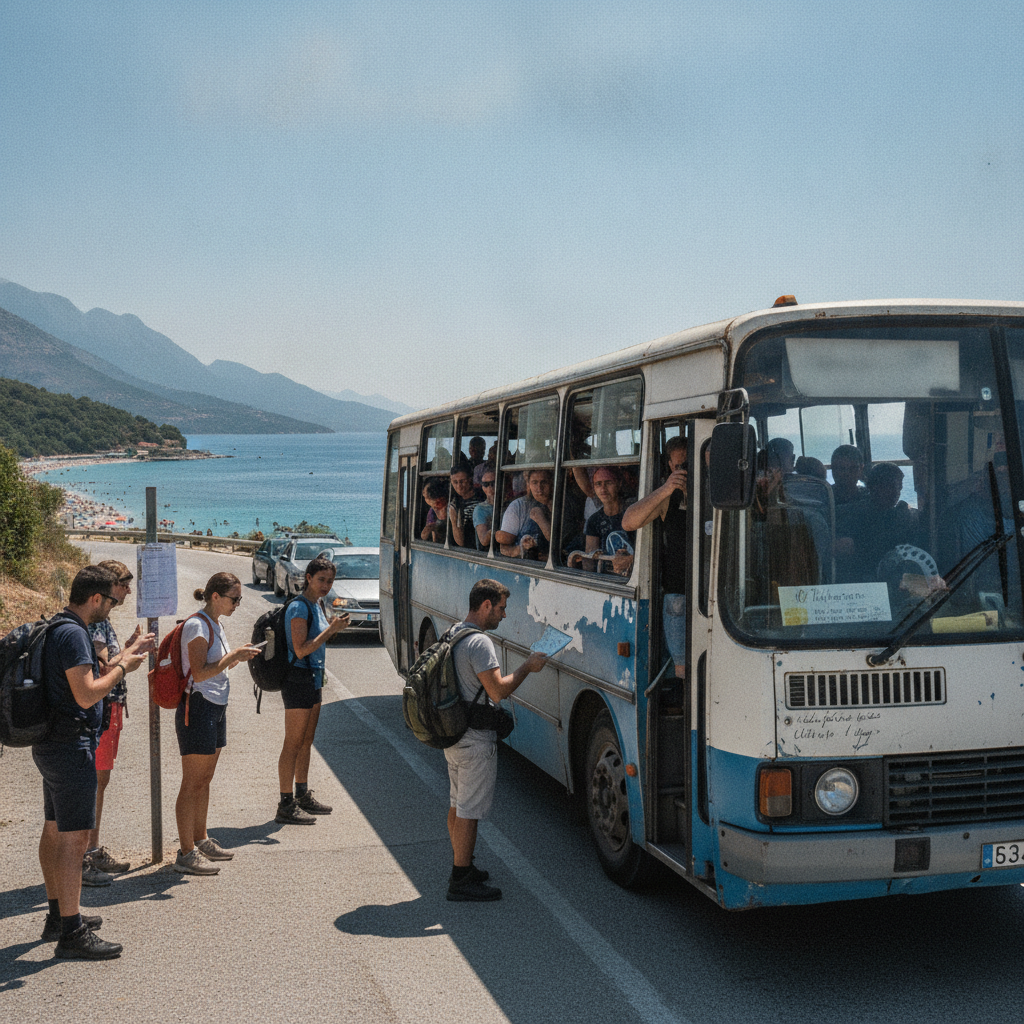
Budget travel along the Albanian Riviera has a particular rhythm — slower, less predictable, and far more dependent on the season than most guidebooks suggest. In summer, the coastal road between Vlorë and Sarandë becomes one of the busiest stretches in the country, with local furgons and public minibuses running alongside tourist vans and rental cars. Choosing to rely on the local bus network rather than renting a car or booking private transfers is a decision that shapes the entire character of a trip, and it's worth understanding exactly what that choice involves before committing to it.
The Realities of Summer Bus Frequency on the Riviera
The backbone of public transport along the Albanian Riviera is the furgon — a shared minibus that typically runs between larger towns rather than on a fixed timetable. In summer, the Vlorë to Himarë corridor sees reasonably consistent service, with furgons departing throughout the morning and tapering off significantly after midday. Between Himarë and Sarandë, the service remains functional but thinner, and the gaps between departures can stretch to two or three hours without warning. Travelers who plan to visit smaller villages like Palasë or Dhermi on day trips need to reckon honestly with this: catching an afternoon furgon back to your base is not guaranteed, and the consequences of missing the last one range from an expensive taxi to an unplanned overnight stay.
Summer also brings a complication that doesn't exist in spring or autumn: competition for seats. The coastal road draws both Albanian domestic tourists and an increasing number of international visitors, and popular furgons departing from Himarë or Sarandë on weekend mornings can fill quickly. There's no booking system for these routes — seats go to whoever is standing at the departure point when the vehicle fills. Apps like Rome2rio can give a useful structural overview of the route options, but they don't reflect real-time availability or the informal dynamics of how furgon drivers actually operate along this coast.
What You Gain and What You Give Up
Traveling by local bus on the Albanian Riviera is genuinely affordable by any standard, and that financial ease is real. A seat from Vlorë to Sarandë via the coastal road costs a fraction of what a private transfer charges, and for longer stays, the savings accumulate in ways that matter. But the trade-off is almost always time. A journey that a rental car completes in around two hours can take twice that when accounting for wait times, intermediate stops, and the general unpredictability of summer scheduling. Travelers who have built tight itineraries around seeing multiple beaches in a single day will find the local bus network frequently forces a choice: fewer places, or more rushing.
Flexibility is the subtler cost. The freedom to stop spontaneously at an unmarked viewpoint, to linger at Gjipe Beach longer than planned, or to double back to a village you passed through too quickly — these moments are simply harder to access without private transport. The furgon moves on its own schedule and stops where the driver decides. For some travelers, this constraint is part of the charm, a reminder that slow travel produces its own unexpected rewards. For others, especially those with limited time or specific beach destinations in mind, it can feel genuinely limiting rather than liberating.
Timing Your Moves to Work With the System
The travelers who make local bus travel along the Riviera work well are almost always the ones who plan departures early. Furgons heading south along the coast tend to leave in the morning — often between seven and ten — and this pattern holds more reliably than afternoon services. Building a daily rhythm around early movement, then settling into a beach or village for the bulk of the afternoon, aligns naturally with how the transport system actually functions. Trying to use the buses for late afternoon or evening movement between towns is where plans most frequently come apart.
For practical scheduling, Google Maps has expanded its coverage of Albanian transit routes, though its real-time accuracy along the Riviera remains inconsistent. Checking it alongside local Facebook groups for expats and travelers in Albania — particularly those focused on Sarandë or the southern coast — often surfaces more current information about which routes are running and at what frequency. The Albania Travel Facebook community, for instance, regularly carries firsthand reports during summer that no app replicates. Pairing that kind of peer intelligence with a downloaded offline map from Maps.me gives a more complete operational picture than any single source.
Accommodation location matters more than most travelers initially account for. Staying in Himarë rather than a smaller village keeps more transport options open. Himarë sits roughly in the middle of the Riviera and has more frequent furgon connections north toward Vlorë and south toward Sarandë than any of the smaller coastal stops. Using it as a base for three or four days rather than moving every night reduces the number of times you're gambling on transport availability and still allows access to the most celebrated stretches of coastline on foot or by occasional taxi.
The Albanian Riviera rewards the kind of traveler who holds plans loosely — who books accommodation in advance but doesn't fix every day to a specific beach or village. The local bus network, with all its summer chaos and charm, is genuinely manageable when approached with that spirit. The coast itself is dramatic enough that an afternoon spent at the one beach you could actually reach tends to feel like a good day, not a compromise. The same slow quality that makes the furgon system unpredictable is what keeps this stretch of coastline feeling unhurried, uncrowded by comparison to more tourist-saturated European coasts, and worth the occasional long wait in the heat.